










Most adults were never formally taught how money works. We picked it up through a mix of observation, trial and error, and sometimes costly mistakes. If you are a parent, you have the chance to change that for your children — and the earlier you start, the more natural money skills become.
The good news is that teaching kids about money does not require a finance degree or a complicated curriculum. It requires everyday conversations, age-appropriate experiences, and a willingness to let children make small mistakes with small amounts of money while the stakes are low.
This guide covers how to teach kids about money at every age — from preschool through the teenage years. You will find practical money lessons for children organized by developmental stage, along with age-appropriate money skills that build on each other as your child grows.
If you are also working on your own household budget, this pairs naturally with our guide on household budgeting for families — because the way your family manages money is the most powerful lesson your children will receive.
Why Teaching Kids About Money Matters
Children form money habits earlier than most parents realize. By age seven, many have already developed basic attitudes toward spending and saving that can follow them into adulthood.
Kids Learn by Watching
The most powerful money lessons do not come from lectures — they come from observation. Children watch how you talk about money, how you make spending decisions, and how you handle financial stress. If money is a source of tension at home, they absorb that. If budgeting is a normal, calm conversation, they absorb that too.
Early Habits Last
Research in financial behavior suggests that money habits form early and are difficult to change later. A child who learns to save part of a gift at age six is more likely to save part of a paycheck at age twenty-six. The skill is the same — only the amounts change.
Small Mistakes Now Prevent Big Mistakes Later
Letting a child spend all their allowance on something they regret is a cheap lesson. Letting an eighteen-year-old learn the same lesson with a credit card is an expensive one. Early experience with money, including small mistakes, builds the judgment that prevents costly errors later.
Age-by-Age Guide: Money Skills at Every Stage
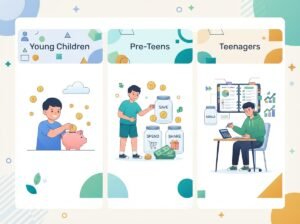
The table below summarizes the core focus at each stage. Detailed guidance for each age group follows.
| Age Group | Core Focus | Key Skills to Introduce |
|---|---|---|
| Ages 3–5 | Basic concepts | Coins and bills exist, saving in a jar, waiting before buying |
| Ages 6–9 | Saving and choosing | Allowance, save-spend-give jars, comparing prices |
| Ages 10–12 | Budgeting basics | Planning a purchase, tracking spending, wants vs needs |
| Ages 13–15 | Independence | Earning their own money, bank accounts, saving for goals |
| Ages 16–18 | Real-world prep | Budgeting, debit cards, compound interest, avoiding debt |
Ages 3–5: Introducing the Idea of Money
At this age, the goal is not technical understanding — it is exposure. Children should learn that money is a thing, that it is used to buy things, and that saving is something people do.
Talk About Money Casually
When you shop, narrate simple choices out loud. “This one costs less, so we will buy this one today.” You are not teaching a lesson — you are normalizing money talk so it does not feel taboo.
Use a Clear Savings Jar
A clear jar is better than an opaque piggy bank at this age because children can see the money growing. Drop coins in together and talk about how the jar is getting fuller. The visual makes the abstract concept of saving real.
Teach the Idea of Waiting
Young children struggle with delayed gratification, but this is a core money skill. If they want a small toy, help them save coins over a few weeks to buy it. The experience of waiting and then achieving the goal teaches patience and planning.
Ages 6–9: Saving, Spending, and Giving
This is the age when children can start handling small amounts of money and making simple choices.
Start an Allowance
An allowance gives children money to practice with. The amount is less important than the fact that they have their own money to manage. A common guideline is one dollar per week per year of age, but choose an amount that fits your household.
Use Save, Spend, and Give Jars
Divide allowance into three jars: one for saving, one for spending, and one for giving. This teaches that money has different purposes — not just spending. The giving jar introduces generosity as part of money management.
Let Them Make Small Mistakes
If your child wants to spend their entire spending jar on a toy they will lose interest in by next week, let them. The regret is the lesson, and it costs only a few dollars now. Better to learn it at seven than at twenty-seven.
Compare Prices Together
When shopping, involve them in simple price comparisons. “This brand costs two dollars more — is it worth it?” This builds the habit of thinking before spending, which is the foundation of all money management.
Ages 10–12: Budgeting Basics and Trade-Offs
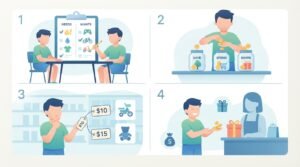
At this stage, children can grasp the concept of limited resources and trade-offs. They can also begin planning purchases that require saving over time.
Introduce Wants vs Needs
Help your child distinguish between things they need and things they want. This is not always obvious to a child — a new video game feels like a need. Walk through examples and let them practice categorizing.
Plan a Purchase Together
Pick something your child wants that costs more than one allowance. Help them figure out how many weeks of saving it will take, and let them track their progress. This teaches planning and delayed gratification with a concrete goal.
Let Them Budget for a Specific Event
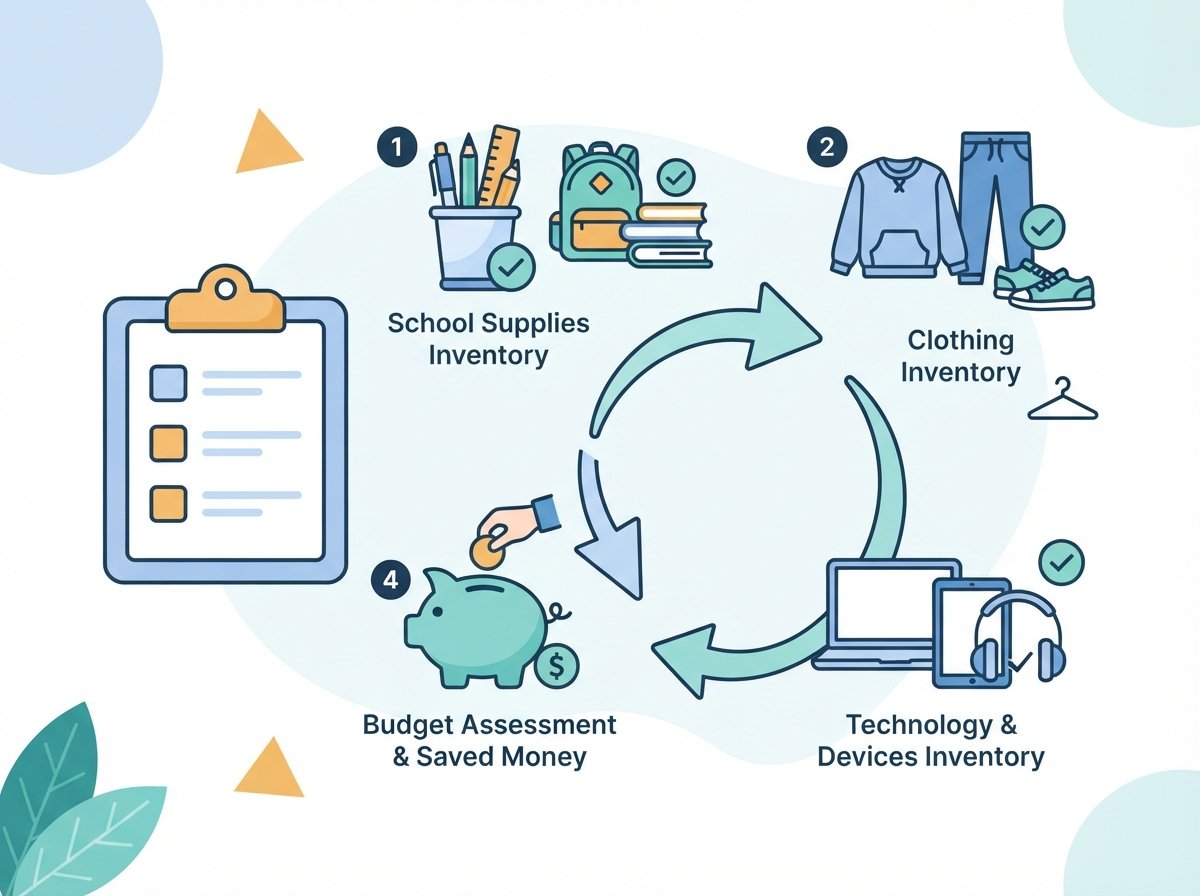
Give your child a set amount for a specific purpose — for example, back-to-school supplies or a birthday gift for a friend — and let them decide how to spend it. If they run out before covering everything, that is the lesson. See our back-to-school budgeting guide for ways to structure this.
Start Tracking Spending
Introduce a simple notebook or basic tracking sheet where they write down what they earn, spend, and save. The act of writing it down builds awareness — the same skill they will need later with a bank account and budgeting app.
Ages 13–15: Earning and Independence
Teenagers are ready for more independence and for the idea that money is earned, not just given.
Encourage Earning
At this age, children can start earning their own money through small jobs — babysitting, lawn mowing, pet sitting, or helping neighbors. Earning their own money changes how children value it. Money they worked for is spent more carefully than money they were given.
Open a Bank Account
Many banks offer teen or joint accounts with a parent. This introduces the mechanics of banking — deposits, withdrawals, tracking balances — in a controlled way. It also makes saving more formal than a jar.
Set a Savings Goal
Help your teen set a savings goal — a device, a trip, a car contribution — and track progress. The goal should be meaningful to them, not to you. A goal they care about teaches motivation and persistence.
Introduce the Concept of Interest
Explain in simple terms that money saved can grow over time through interest or investment returns. You do not need to cover the full math — just the idea that money not spent can earn more money. This sets up later conversations about investing.
Ages 16–18: Real-World Preparation
Older teenagers are approaching financial independence. This is the time to introduce the tools and concepts they will need as adults.
Teach Budgeting with Real Numbers
If your teen has a part-time job or regular allowance, help them build a simple budget — income, fixed costs (like phone or car gas), savings, and spending. This is the same skill they will need at eighteen, just at a smaller scale.
Introduce a Debit Card
A debit card linked to their bank account teaches them to manage money without borrowing — unlike a credit card. They learn to track spending, check balances, and avoid overdrawing. The consequences are real but contained.
Explain Credit Cards and Debt
Before they encounter credit card offers at college or in the mail, explain how credit cards work, how interest compounds, and how easily debt can grow. They do not need a credit card yet, but they need to understand the danger.
Talk About Compound Interest and Investing
Introduce the idea that investing small amounts over long periods can grow significantly. You do not need to teach portfolio theory — just the principle that time and consistency matter more than perfect timing. This connects to our holiday budgeting guide and other spending plans: the money not overspent during the holidays is money available to save and grow.
Let Them Manage a Larger Budget
Give your teen responsibility for a real household budget category — their clothing budget, for example, or a portion of the grocery budget. Let them make the decisions and live with the results. Real responsibility teaches faster than any lecture.
Real-World Example: One Family’s Age-by-Age Approach
Consider a family with three children at different stages.
Age 5 — Saving jar and waiting:
The youngest receives coins for small chores and puts them in a clear jar. They wanted a small toy and saved for three weeks to buy it. The lesson: waiting works, and saving gets you to a goal.
Age 10 — Budgeting for back-to-school:
The middle child is given a set amount for school supplies and clothing. They list what they need, compare prices, and realize they cannot afford both the expensive backpack and the new shoes. They choose. The lesson: money is finite and choices involve trade-offs.
Age 16 — Part-time job and a debit card:
The oldest gets a part-time job and opens a bank account with a debit card. They budget their income: gas money, phone bill, savings for a used car, and spending money. The first month they overspend and have to skip a movie night. The lesson: tracking matters, and spending more than you earn has immediate consequences.
Three children, three stages, one consistent principle: let them experience money with real stakes at a scale they can handle.
Common Mistakes to Avoid When Teaching Kids About Money
- Lecturing instead of letting them experience: A lecture is forgotten; a small mistake with their own money is remembered.
- Tying all allowance to chores: Some families tie every dollar to a task. This can work, but be aware that it turns money into a transaction rather than a teaching tool. Consider a base allowance plus extra for specific jobs.
- Never letting them fail: Small failures with small amounts are the cheapest education you will ever buy for your child.
- Making money a taboo topic: If money is never discussed, children learn that it is stressful or shameful. Normal, calm money talk builds comfort.
- Giving teenagers too much too fast: A debit card without budgeting lessons leads to overspending. Build skills before adding tools.
- Rescuing every mistake: If you always replace the money they spent poorly, they learn there is no consequence. Let them feel the gap.
- Waiting too long to start: The earlier children are exposed to money concepts, the more natural they feel. Do not wait until the teenage years to begin.
- Focusing only on saving: Saving is important, but children also need to learn spending wisely and giving. All three are money skills.
Frequently Asked Questions
At what age should I start teaching my kids about money?
You can start as early as age three or four with basic concepts like coins, saving in a jar, and the idea of waiting before buying. The lessons become more structured as children grow, but early exposure builds comfort with money.
Should I give my child an allowance?
An allowance is a useful tool because it gives children money to practice managing. The amount is less important than the fact that they have their own money to make decisions with. A common guideline is one dollar per week per year of age, but choose what fits your household.
Should allowance be tied to chores?
There is no single right answer. Some families tie allowance to chores to teach the connection between work and earning. Others provide a base allowance plus extra for specific jobs. The key is to be consistent and to use allowance as a teaching tool, not just a payment.
How do I teach my teenager about budgeting?
If your teen has income from a part-time job or allowance, help them build a simple budget: income, fixed costs, savings, and spending. Let them track it and experience the consequences of overspending. Real numbers and real stakes teach faster than lectures.
Should I give my teenager a credit card?
Most teenagers do not need a credit card, but they do need to understand how credit works before they encounter offers on their own. Start with a debit card linked to a bank account, which teaches money management without the risk of borrowing. Explain credit cards, interest, and debt before they leave home.
How do I teach my child to save?
Start with a clear savings jar so they can see money growing. As they get older, move to a bank account and help them set savings goals. Let them save for something they care about — the motivation is stronger when the goal is theirs.
What if my child spends all their money on something foolish?
Let them. A small regrettable purchase with a small amount of money is a cheap and effective lesson. Resist the urge to rescue them. The experience of wishing they had saved teaches more than any lecture.
How does teaching kids about money fit with our family budget?
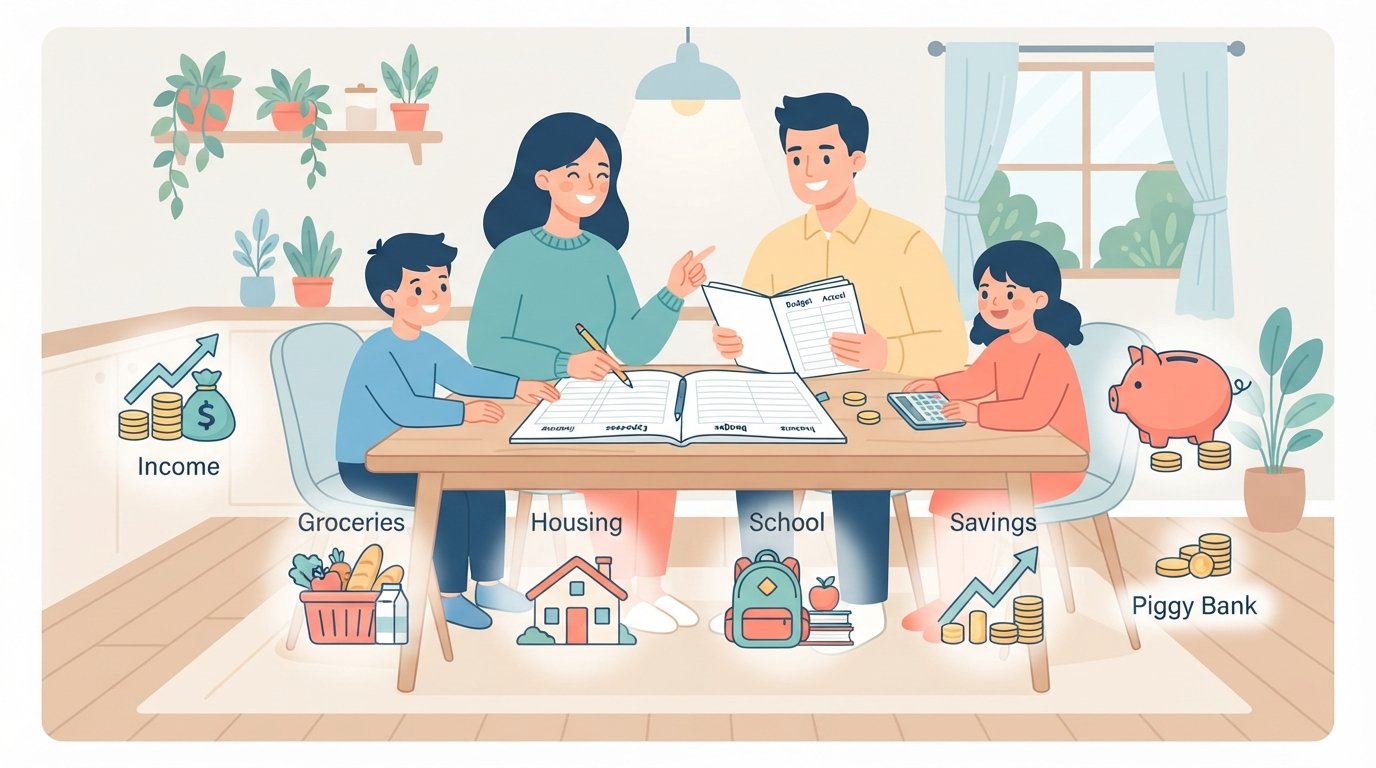
The way your family manages money is the most powerful lesson your children receive. Involving them at an age-appropriate level in household decisions — like back-to-school spending or holiday planning — connects their personal money skills to the bigger picture. See our guide on household budgeting for families for the full framework.
Key Takeaways
- Children form money habits early — by age seven, many basic attitudes toward money are already forming.
- The most powerful money lessons come from observation and experience, not lectures.
- At ages 3–5, focus on basic exposure: coins, saving in a jar, and the idea of waiting.
- At ages 6–9, introduce allowance and the save-spend-give framework.
- At ages 10–12, teach budgeting basics, wants vs needs, and planning purchases.
- At ages 13–15, encourage earning and introduce bank accounts and savings goals.
- At ages 16–18, teach real-world skills: budgeting, debit cards, credit, and compound interest.
- Let children make small, cheap mistakes now to prevent expensive mistakes later.
- The way your family manages money together is the strongest lesson of all.
To continue, read our guides on back-to-school budgeting and holiday budgeting for practical ways to involve kids in seasonal spending decisions. For the full family money management framework, see our pillar guide on household budgeting for families.
Teaching kids about money is not about raising mini accountants — it is about giving them the confidence and judgment to manage their own financial lives when the stakes are real. Start early, let them practice, and the skills will be second nature by the time they need them.
This article is for informational purposes only and is not financial advice. Family circumstances and children’s developmental needs vary. Adapt these suggestions to what works for your household.


2 thoughts on “How to Teach Kids About Money at Every Age”