









Every year, the same thing happens. Summer is in full swing, and then suddenly it is August — and the back-to-school spending season arrives with a bill that catches most families off guard.
Between school supplies, new clothes, activity fees, technology, and the dozen small costs that appear on classroom lists, back-to-school is one of the largest seasonal spending events for families with children. For many households, it is second only to the holidays.
The problem is not the spending itself — children genuinely need supplies and clothes for a new school year. The problem is that most families approach it reactively, buying everything in a single rushed week, paying full price, and blowing a hole in their monthly budget.
This guide shares practical back to school budgeting tips that help you save money back to school shopping and build a back to school budget that does not derail the rest of your household plan. With a little timing and strategy, the same list of items can cost significantly less.
If you have not yet built an overall household money plan, start with our guide on household budgeting for families — back-to-school is one seasonal cost within that bigger picture.
Why Back-to-School Spending Sneaks Up on Families
Back-to-school is expensive, but the real issue is timing. The costs arrive in a narrow window — usually a single month — and they arrive after a summer that may have already stretched the budget with camps, trips, and activities.
The Costs Are Concentrated
Unlike groceries or utilities, which spread evenly across the year, back-to-school spending hits in one burst. A $400 to $600 bill that arrives in a single month can push a tight budget into the red, even if the family could absorb that same amount spread across three months.
Supply Lists Grow Every Year
Classroom supply lists have expanded beyond pencils and notebooks. Many now include tissues, hand sanitizer, headphones, USB drives, and specific brands or models. The list feels mandatory, and parents feel pressure to buy everything on it.
Kids Grow — and Clothes Do Not Last
Children outgrow clothes and shoes between school years, sometimes dramatically. A child who grew two inches over the summer may need an entirely new wardrobe, not just one or two items.
Technology Adds a New Cost Layer
Tablets, laptops, calculators, and headphones are now standard requirements in many schools. These are the most expensive items on most back-to-school lists, and they are the hardest to reduce.
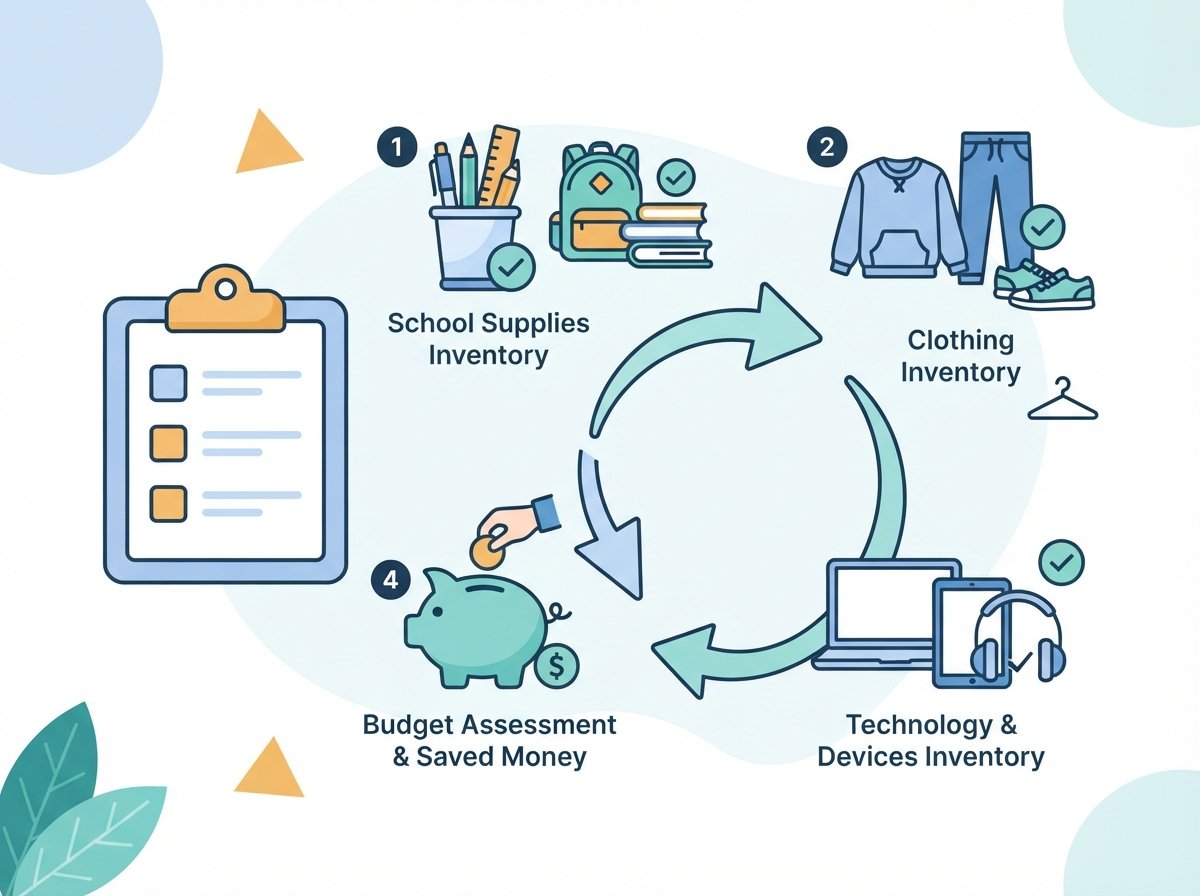
Step 1: Start With a Master Inventory
Before buying anything, find out what you already have. This single step saves most families more money than any coupon or sale.
Check Supplies First
Go through last year’s leftover supplies. Pencils, pens, markers, scissors, rulers, erasers, and folders are often still usable. Many come home at the end of the year barely touched. Sort them into a “reuse” pile before writing a single item on a shopping list.
Check Clothing and Shoes
Have your child try on their school clothes and shoes. You may discover that half of last year’s wardrobe still fits. Make a list of what is actually needed — not what would be nice to have new.
Check Technology
Does the laptop still work? Does the calculator from last year still function? Before upgrading, confirm that the current device meets the school’s requirements. A working device does not need replacing just because a newer model exists.
Make a “Have” List and a “Need” List
Write down what you already have on one side and what you genuinely need on the other. Your shopping list should only include the “need” side — the gap between what you own and what is required.
Step 2: Build a Back-to-School Budget
Once you know what you need, assign a dollar amount to each category before you start shopping.
Set a Total Spending Limit
Decide the total amount you can spend without derailing your monthly budget. If you have been saving for back-to-school throughout the year using a sinking fund, this amount is already set. If not, identify how much you can spend from this month’s budget without going into debt.
Break the Budget Into Categories
| Category | What It Covers | Typical Share of Budget |
|---|---|---|
| School supplies | Pencils, notebooks, folders, required classroom items | 20–25% |
| Clothing and shoes | Uniforms, everyday clothes, shoes, outerwear | 30–40% |
| Technology | Laptop, tablet, calculator, headphones | 20–30% |
| Activities and fees | Registration, sports, clubs, field trips | 10–15% |
| Buffer | Unexpected items that appear after school starts | 5–10% |
The percentages are examples — your split will depend on your child’s age and your school’s requirements. The point is to assign money to each category so you do not overspend in one and run short in another.
Include a Buffer
Every parent knows that a supply list will grow after the first day of school. A teacher will request an additional item, a fee will appear, or a club will require equipment. Set aside a small buffer so these costs do not catch you off guard.
Step 3: Shop Strategically to Save Money

With your list and budget in hand, the way you shop determines how much you save. These strategies work regardless of your total budget.
Shop Early — But Not Too Early
Sales begin in mid-summer, but the best discounts often appear in the weeks just before school starts, when stores compete for last-minute shoppers. Watch for tax-free shopping days in your area, which can save the sales tax on clothing and supplies.
Compare Prices Across Stores
No single store has the best price on everything. Office supply stores may have the cheapest notebooks, while big-box stores may win on clothing, and online retailers may offer the best technology prices. A few minutes of comparison can save a meaningful amount across a full list.
Buy Supplies in Bulk for Multiple Children
If you have more than one school-age child, buy common supplies like pencils, paper, and folders in bulk and divide them. Bulk packs are often significantly cheaper per item than individual packages.
Stick to the List
This is the hardest rule for many parents. Children will see items they want — a fancy backpack, a trendy lunchbox, a specific brand of shoes. If it is not on the “need” list, treat it as a want and either skip it or let your child use their own money. See our guide on how to teach kids about money at every age for ways to involve children in these trade-off decisions.
Consider Used and Refurbished Technology
For expensive items like laptops and calculators, consider refurbished models from reputable sellers. They often carry the same warranty as new devices and cost significantly less. For college students and older teens, our guide on textbook and school supply hacks covers similar strategies for higher education costs.
Spread Clothing Purchases Across the Year
Children do not need an entirely new wardrobe in August. Buy what they need to start the year, then spread additional clothing purchases across the fall. This smooths the spending and takes advantage of later sales — and it avoids buying winter clothes that may not fit by the time the weather turns.
Step 4: Involve Your Child in the Budget
Back-to-school is one of the best real-world money lessons a child can experience. Instead of doing all the shopping yourself, involve your child in the budget.
Give Them a Category to Manage
Hand your child a set amount for one category — school supplies, for example — and let them make the choices within that budget. If they choose the expensive backpack, they will have to save on something else. The trade-off teaches more than any lecture.
Let Them Feel the Trade-Offs
If your child wants an item that exceeds the budget, offer them a choice: use their own savings to cover the difference, or choose a less expensive alternative. This turns a potential argument into a financial decision — one they make and own.
Talk About the Budget Out Loud
Narrate your own trade-off decisions while shopping. “If we buy the cheaper notebooks, we have more left for the shoes you need.” This normalizes budget thinking and shows that trade-offs are how adults manage money, not a sign of deprivation.
Real-World Example: One Family’s Back-to-School Budget
Consider a family with two school-age children, ages 8 and 12, and a total back-to-school budget of $500.
Step 1 — Inventory:
They check last year’s supplies and find reusable scissors, rulers, colored pencils, and several notebooks. They try on clothes and discover the younger child’s uniform still fits, while the older child needs new shoes and two pairs of pants. The laptop from last year still works for both.
Step 2 — Budget allocation:
- School supplies: $120
- Clothing and shoes: $200
- Technology: $0 (existing devices still work)
- Activities and fees: $100
- Buffer: $80
Step 3 — Shopping:
They compare prices across three stores and find notebooks for 25 cents at one store versus $1.50 at another. They buy common supplies in a bulk pack and split them between both children. They buy the older child’s shoes during a sale and delay two clothing purchases until October.
Step 4 — Involving the kids:
The older child is given $60 for supplies and chooses a mid-range backpack instead of the premium one, using the remaining money for a notebook style they prefer. The younger child picks between two lunchbox options within their budget.
Final spending: $415, with $85 of the budget left unspent — well below the $500 limit, without buying less than what was needed.
The savings came from the inventory step, price comparison, bulk buying, spreading clothing purchases, and using existing technology. No coupon-clipping obsession required — just planning.
Common Back-to-School Budgeting Mistakes to Avoid
- Waiting until the last week: Rushed shopping means paying full price and skipping comparisons.
- Skipping the inventory: Buying what you already have is the most common waste.
- Buying everything new: Reusing supplies and refurbished technology can save hundreds.
- Not setting a spending limit: Without a total budget, spending drifts upward with every aisle.
- Buying a full wardrobe in August: Children may outgrow fall clothes before winter; spread the purchases.
- Ignoring the buffer: Additional items always appear after school starts; plan for them.
- Letting children add to the cart without limits: Involve them, but within a budget they manage.
- Forgetting activity fees: Sports, clubs, and field trips are part of back-to-school costs — include them.
- Assuming the supply list is a minimum: Some listed items are suggestions, not requirements. Check with the teacher if you are unsure.
- Not saving across the year: The best approach is a monthly sinking fund so the money is ready when August arrives.
Frequently Asked Questions
How much should I budget for back-to-school?
The right amount depends on the number of children, their ages, and your school’s requirements. A common range is $200 to $600 per child for supplies, clothing, and basic technology, but your actual number should be based on your inventory and needs — not a national average.
When is the best time to shop for back-to-school supplies?
The best discounts typically appear in the weeks just before school starts, when stores compete for last-minute shoppers. Watch for tax-free shopping days in your area, and compare prices across stores rather than buying everything in one place.
How can I save money on back-to-school shopping?
Start with an inventory of what you already have, set a category budget, compare prices across stores, buy common supplies in bulk, consider refurbished technology, and spread clothing purchases across the year. The inventory step alone saves most families more than any sale.
Should I buy a new laptop for my child every year?
Usually not. If the current device meets the school’s requirements and still works, there is no need to upgrade. Consider refurbished models when replacement is necessary — they often carry the same warranty at a lower price.
How do I involve my child in back-to-school budgeting?
Give them a category to manage within a set amount, and let them make the trade-off decisions. If they want an item that exceeds the budget, offer the choice of using their own savings or picking a cheaper alternative. See our guide on how to teach kids about money at every age for age-by-age strategies.
What if the supply list is very long?
Some items on classroom lists are suggestions rather than strict requirements. If the list seems excessive, check with the teacher about which items are essential on day one. You can also spread non-urgent purchases across the first few weeks of school.
Should back-to-school costs be part of my household budget?
Yes. Back-to-school is a predictable annual expense, which means it should be planned for with a monthly sinking fund rather than paid out of a single month’s budget. See our guide on household budgeting for families for how to build this into your overall plan.
How do I handle back-to-school costs for college students?
College back-to-school costs include textbooks, which are often the largest expense. Textbook rental, used books, and digital editions can save hundreds per semester. See our guide on textbook and school supply hacks for strategies specific to higher education.
Key Takeaways
- Back-to-school is one of the largest seasonal spending events for families, and its concentrated timing is what makes it stressful.
- Start with a master inventory — finding what you already have saves more than any sale.
- Build a category-based budget with a buffer for items that appear after school starts.
- Shop strategically: compare prices, buy in bulk, consider refurbished technology, and spread clothing purchases.
- Involve your child in the budget so they learn trade-offs through real decisions.
- Reuse supplies and devices that still work — new is not always necessary.
- Plan for activity fees and field trips, not just supplies and clothes.
- Save monthly across the year using a sinking fund so the money is ready when August arrives.
To build back-to-school costs into your full household money plan, read our pillar guide on household budgeting for families. For ways to involve your children in money decisions year-round, see how to teach kids about money at every age. And for college-level supply savings, read our guide on textbook and school supply hacks.
Back-to-school does not have to be a budget emergency. With an inventory, a plan, and a few smart shopping strategies, the same list of items can cost far less — and the process can teach your children something about money along the way.
This article is for informational purposes only and is not financial advice. Budgeting needs and school requirements vary by household, location, and school district.



One thought on “Back-to-School Budgeting: How to Save Without the Stress”