








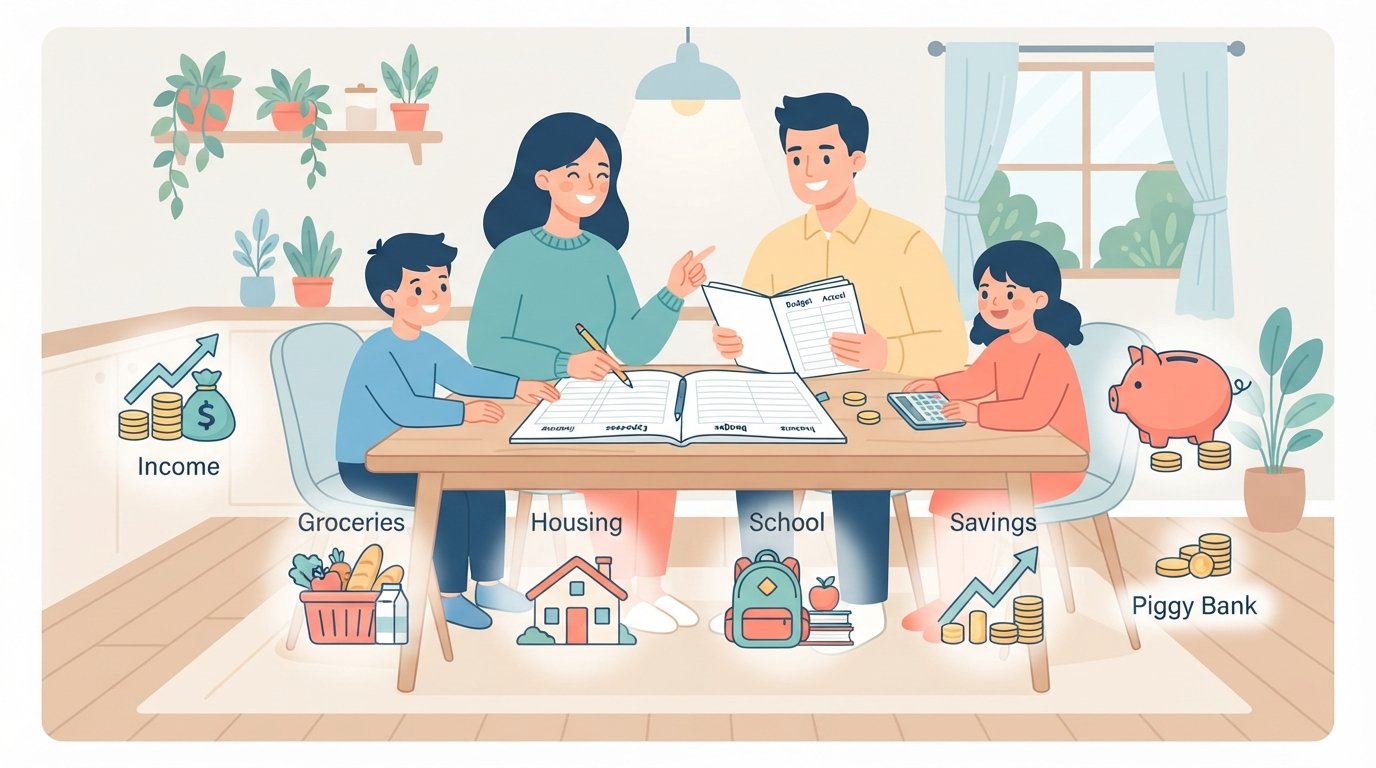
Budgeting on your own is one thing. Budgeting with a partner, children, a mortgage, grocery bills that seem to grow every month, school costs, activities, and the occasional unexpected medical bill — that is a different challenge entirely.
Household budgeting for families is not just about numbers on a spreadsheet. It is about coordinating multiple people, competing priorities, and irregular costs that do not show up every month but always show up eventually. The good news is that a few simple systems make it manageable — and once the whole household is on the same page, money becomes less of a source of stress and more of a tool for shared goals.
This family budget guide walks through how to budget as a family from the ground up: how to track household income and expenses, how to handle irregular costs, how to involve partners and kids, and how to build a system that survives the chaos of real family life.
If money conversations feel tense at home, start with our guide on how to build a healthy relationship with money — mindset and communication come before the spreadsheet.
Why Family Budgeting Is Different
A single-person budget is simple: one income, one set of expenses, one person making every decision. A family budget multiplies every one of those factors.
More Income Sources to Coordinate
A household may have two earners with different pay schedules, freelance income, child benefits, or support payments. Coordinating multiple income streams into one plan requires a system, not just a rough mental estimate.
More Expense Categories
Families carry expenses that single-person budgets often do not: childcare, school costs, children’s activities, growing grocery bills, larger housing costs, and family insurance. Each category grows as children grow, and the budget needs to keep up.
Irregular and Seasonal Costs
School supplies, holiday spending, birthday gifts, vehicle repairs, and medical bills do not arrive monthly — but they arrive every year. A family budget that only tracks monthly expenses will be blindsided by costs it forgot to plan for.
Multiple Decision-Makers
When two adults share a household, money decisions need to be shared. When one person controls the budget and the other is left out, resentment and misunderstanding build quickly. A good family budget is a shared plan, not a solo project.
Step 1: Gather Every Source of Income and Every Expense
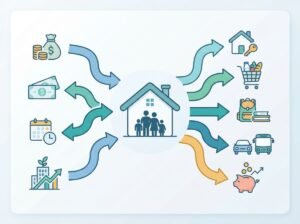
The first step is visibility. You cannot budget for money you cannot see.
List All Income
Write down every source of income the household receives, including:
- Salaries and wages (after tax)
- Freelance or side income
- Child benefits or support payments
- Any other regular income
Use after-tax numbers — the amount that actually lands in your account — so the budget reflects real spendable money.
List All Monthly Expenses
Go through one to three months of bank and card statements and group spending into categories:
| Category | Typical Examples |
|---|---|
| Housing | Rent or mortgage, property tax, home insurance |
| Utilities | Electricity, gas, water, internet, phone |
| Food | Groceries, school lunches, occasional takeout |
| Transport | Fuel, car payment, insurance, public transit |
| Childcare | Daycare, after-school care, babysitting |
| School | Supplies, fees, activities, uniforms |
| Health | Insurance premiums, prescriptions, co-pays |
| Debt | Credit card minimums, student loans, other loans |
| Household | Cleaning supplies, maintenance, toiletries |
| Family life | Birthdays, activities, sports, lessons |
| Savings | Emergency fund, retirement, education fund |
List Irregular and Annual Expenses
This is the step most families miss. Identify costs that do not happen monthly but are predictable across a year:
- Holiday and birthday spending
- Back-to-school shopping
- Annual insurance premiums
- Vehicle registration and maintenance
- Medical costs not covered by insurance
- Home repairs
Total each one for the year, divide by 12, and add that monthly amount to your budget as a sinking fund. This way, the money is there when the cost arrives.
Step 2: Choose a Budgeting Framework
Once you can see all income and expenses, choose a structure for allocating the money. Three frameworks work well for families:
The 50/30/20 Rule
- 50% to needs (housing, food, utilities, transport, childcare)
- 30% to wants (activities, entertainment, dining out, hobbies)
- 20% to savings and debt repayment
This is a simple starting point, but for families in higher-cost areas, the needs portion may exceed 50% — adjust the percentages to fit your reality.
The Zero-Based Budget
Every dollar is assigned a job before the month begins. Income minus expenses equals zero — not because you spend it all, but because every dollar is allocated, including savings and sinking funds.
This is the most precise method and works well for families who want full control, but it requires more upkeep.
The Pay-Yourself-First Method
Before paying any bills or spending anything, a set amount goes to savings and debt repayment. The rest covers household expenses. This method ensures savings do not get crowded out by rising family costs.
Step 3: Build the Family Budget Together

A family budget only works if the family is involved. Here is how to build it as a shared project:
Hold a Monthly Budget Meeting
Set aside 20 to 30 minutes at the end of each month to review what happened and plan the next month. Both adults should attend. Cover:
- What was earned and spent last month
- What was over or under budget and why
- What irregular costs are coming next month
- What needs to change
Agree on Shared Goals
A budget without goals feels like restriction. A budget with goals feels like progress. Pick one or two shared goals — an emergency fund, a family trip, paying off a credit card — and make them visible.
Decide How to Handle Shared and Individual Money
Some families pool all income into shared accounts. Others keep individual accounts and contribute to a shared one for household expenses. There is no single right answer, but there should be an explicit agreement rather than an unspoken assumption.
Involve Kids at an Age-Appropriate Level
Children do not need to see every number, but they benefit from understanding that money is finite and choices have trade-offs. See our guide on how to teach kids about money at every age for age-by-age strategies.
Step 4: Handle the Seasonal Costs That Derail Family Budgets
Irregular costs are the number one reason family budgets fail. Plan for them in advance.
Back-to-School
School supply and clothing costs arrive every year, usually in a single expensive month. Estimate the annual total, divide by 12, and save that amount monthly. See our back-to-school budgeting guide for ways to reduce the cost.
Holidays
Holiday spending is predictable in timing but often underestimated in total. Plan the full cost — gifts, food, travel, decorations — before the season begins. See our holiday budgeting guide for a realistic plan that avoids January debt.
Family Vacation
Travel is one of the largest discretionary expenses for families, and it is also one of the easiest to overspend on. Plan and save in advance using a dedicated sinking fund. See our guide on planning a family vacation on a budget for a step-by-step approach.
Birthdays and Events
Children’s birthdays, family celebrations, and school events add up across a year. Set a per-event budget and fund it monthly so no single event creates a surprise.
Step 5: Review and Adjust Regularly
A family budget is not a document you write once. It is a living system that changes as your family changes.
Review monthly, and ask:
- Did our income or expenses change?
- Are any categories consistently over budget?
- Are there new irregular costs to plan for?
- Are we progressing toward our shared goals?
- Do both adults still feel the system is fair?
If something is not working, adjust the system rather than abandoning the budget. A budget that never changes is probably not being used.
Real-World Example: A Family of Four Builds Their First Budget
Consider a household with two earners, two children, and a combined after-tax income of $5,200 per month.
Step 1 — They gather everything:
- Housing (rent + insurance): $1,500
- Utilities and internet: $280
- Groceries: $750
- Transport (fuel + insurance): $320
- Childcare: $600
- Minimum debt payments: $200
- Irregular costs (school, holidays, birthdays, car maintenance) divided by 12: $350
- Total fixed and planned: $4,000
Step 2 — Remaining $1,200 is allocated:
- $400 to emergency fund
- $200 to extra debt repayment
- $300 to activities and family entertainment
- $300 to flexible spending and buffer
Step 3 — They hold a monthly meeting:
The first month, groceries came in at $890 — $140 over. Instead of giving up, they adjusted the grocery target and planned one fewer takeout meal per week.
By month three, the budget was stable, the emergency fund had grown by $1,000, and both adults knew exactly where the money was going — for the first time.
The numbers are illustrative. The system is what matters: visibility, shared decisions, planning for irregular costs, and monthly review.
Common Family Budgeting Mistakes to Avoid
- Leaving one partner out of the budget: A budget one person makes alone will not be followed by the other.
- Ignoring irregular costs: School, holidays, and birthdays are predictable — plan for them monthly.
- Budgeting only monthly: Annual and seasonal costs derail budgets that do not account for them.
- Setting the grocery budget too low: Food is usually the most underestimated family expense.
- Not involving kids at all: Children who understand trade-offs make family spending easier, not harder.
- Failing to adjust when income changes: A new job, a pay cut, or a new baby should trigger a budget review.
- Treating the budget as punishment: Frame it as a tool for shared goals, not a restriction on enjoyment.
- Forgetting to budget for fun: A budget with no room for enjoyment will not last.
- Giving up after one bad month: One overspend does not mean the system failed. Adjust and continue.
Frequently Asked Questions
How do I start a family budget?
Start by gathering every source of income and every expense — including irregular annual costs. Group expenses into categories, divide annual costs by 12, choose a budgeting framework, and hold a monthly budget meeting with your partner.
How do you budget as a family with two earners?
Combine after-tax income from both earners into one plan, or agree on a contribution split if you keep separate accounts. The key is that both adults participate in the budget meeting and agree on shared goals — the account structure is secondary to the communication.
What is the best budgeting method for families?
The best method is the one both adults will actually use. The 50/30/20 rule is a simple starting point, zero-based budgeting offers the most control, and pay-yourself-first ensures savings are not crowded out. Try one and adjust based on what fits your household.
How do I plan for irregular family expenses?
List every cost that does not happen monthly but is predictable across a year — school supplies, holidays, birthdays, car maintenance, annual insurance. Total each one, divide by 12, and save that monthly amount in a sinking fund so the money is ready when the cost arrives.
How much should a family save each month?
A common target is 20% of after-tax income, but the right amount depends on your goals and stage of life. If you are building an emergency fund or paying off debt, more may be needed. If you are just starting, even 5% builds the habit.
Should kids be involved in the family budget?
Yes, at an age-appropriate level. Children do not need to see every number, but they benefit from understanding that money is finite and choices involve trade-offs. See our guide on how to teach kids about money at every age for strategies by age group.
How do couples avoid fighting about the budget?
Hold a regular, calm budget meeting, agree on shared goals, and treat the budget as a team plan rather than a tool for blame. If money conversations are tense, read our guide on how to build a healthy relationship with money before tackling the numbers.
What if our expenses are higher than our income?
Start by identifying which expenses are fixed and which can be reduced. If the gap is small, cutting discretionary spending may close it. If the gap is large, you may need to increase income, reduce housing costs, or address debt. The first step is seeing the full picture — the budget makes the options clear.
Key Takeaways
- Household budgeting for families is about coordination and communication, not just numbers.
- Gather every source of income and every expense, including irregular annual costs that most families forget.
- Choose a budgeting framework — 50/30/20, zero-based, or pay-yourself-first — that both adults will actually use.
- Build the budget together in a monthly meeting; a budget one person makes alone will not last.
- Plan for seasonal costs like back-to-school, holidays, and birthdays using monthly sinking funds.
- Involve children at an age-appropriate level so they understand trade-offs.
- Review and adjust the budget monthly — it is a living system, not a one-time document.
- Frame the budget as a tool for shared goals, not a restriction on family enjoyment.
To go deeper, continue with our guides on how to teach kids about money at every age, back-to-school budgeting, holiday budgeting, and planning a family vacation on a budget. For the mindset and communication side of managing money at home, read our guide on how to build a healthy relationship with money.
A family budget is not about restricting your household — it is about making sure the money you work hard for goes toward what your family actually values, instead of disappearing into spending no one planned for.
This article is for informational purposes only and is not financial advice. Budgeting needs vary by household, income, location, and family circumstances.



4 thoughts on “Household Budgeting: A Complete Guide for Families”