


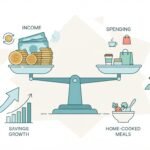



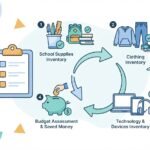


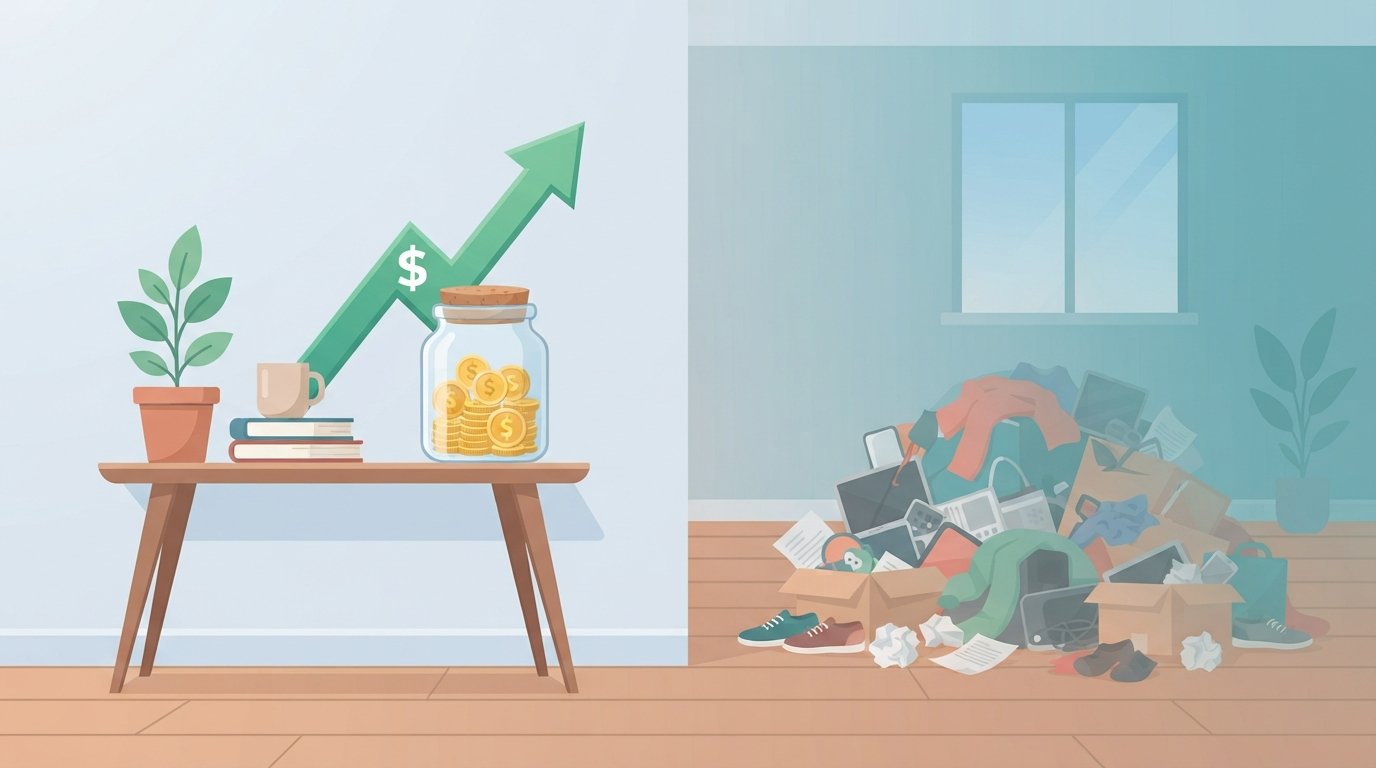
When most people hear “minimalism,” they picture a white-walled apartment with a single chair and a plant. That image is not wrong — it is just incomplete. Minimalism is not really about how your home looks. It is about how your life works.
At its core, minimalism is the practice of keeping only what adds value and removing what does not. Applied to personal finance, that principle becomes surprisingly powerful. Every possession you own costs money to buy, maintain, store, clean, insure, repair, and eventually replace. Owning less is not just an aesthetic choice — it is a financial strategy that directly increases how much you can save.
This guide explores minimalism and money — how the two connect, how minimalism saves money across nearly every spending category, and how to start minimalist living on a budget without becoming the person with one chair and a plant. If you are pursuing financial independence, minimalism may be the most underrated tool in your toolkit.
If you are new to the broader framework, start with our pillar guide on financial independence for beginners — minimalism is one of the lifestyle choices that makes the FIRE math work.
What Minimalism Actually Means
Minimalism is often misunderstood as deprivation, emptiness, or a rejection of comfort. In reality, it is the opposite — it is about keeping what matters and removing what does not, so that the things you keep get more of your attention, money, and time.
Intentional Ownership, Not Empty Rooms
A minimalist does not own nothing. A minimalist owns only things that serve a purpose or bring genuine joy. A kitchen with the tools you actually cook with is minimalist. A wardrobe with clothes you actually wear is minimalist. A home with furniture you use and art you love is minimalist. The point is not the count — it is the intention.
Less Maintenance, More Freedom
Every item you own demands something from you — cleaning, organizing, repairing, storing, or replacing. The more you own, the more of your time and money goes into maintaining your possessions rather than living your life. Minimalism reduces that maintenance cost, freeing both money and hours.
A Filter, Not a Rule
Minimalism is not a strict set of rules about how many shirts you can own or whether you are allowed to have a television. It is a filter you apply to decisions: does this add enough value to justify the cost, space, and upkeep? If yes, keep it. If no, let it go — and do not replace it.
How Minimalism Saves Money: The Hidden Costs of Owning More
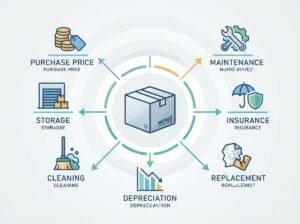
The purchase price of an item is only the beginning. Every possession carries ongoing costs that most people never calculate. Understanding these hidden costs is what makes the connection between minimalism and money so powerful.
The Purchase Price
This is the obvious cost — what you pay to acquire the item. Minimalism reduces this directly by simply buying fewer things.
Maintenance and Repairs
Items break, wear out, and need servicing. A larger home requires more maintenance. More electronics mean more chargers, cases, and repairs. More clothing means more dry cleaning and mending. Every additional item adds to the maintenance burden.
Storage Space
Possessions need space, and space costs money. A larger home, a bigger closet, a storage unit, a bigger car to carry things — all of these are costs driven by the volume of what you own. One of the most powerful financial effects of minimalism is that it reduces the amount of space you need, which can lower your housing costs significantly.
Cleaning and Organizing Time
More things mean more cleaning, more organizing, more time spent managing stuff. While this is not a direct dollar cost, time has real financial value — especially if that time could be spent earning, learning, or resting.
Insurance and Replacement
More valuable possessions mean higher insurance premiums and greater loss risk. If a fire, theft, or disaster occurs, replacing more items costs more. Minimalism reduces both the insurance cost and the replacement risk.
Depreciation and Obsolescence
Most purchases lose value over time. Electronics, furniture, clothing, and vehicles all depreciate. The more you own, the more value you lose to depreciation. Owning fewer depreciating items preserves more of your money.
Mental and Decision Costs
A cluttered environment creates low-level stress and decision fatigue. Studies suggest that visual clutter increases cortisol and reduces focus. While this is not a line item in a budget, it affects productivity, energy, and financial decision-making — all of which have real financial consequences over time.
Minimalist Living on a Budget: Area by Area
Minimalism is not an abstract philosophy — it shows up in specific spending categories. Here is how it reduces costs across the major areas of a household budget.
| Area | How Minimalism Reduces Cost | Estimated Savings |
|---|---|---|
| Housing | Less space needed — smaller home, smaller rent or mortgage | $200–$1,000+/month |
| Clothing | A capsule wardrobe of items you actually wear — fewer purchases | $500–$2,000/year |
| Furniture and decor | Fewer, higher-quality pieces — less replacing and upgrading | $300–$1,500/year |
| Kitchen | Tools you use, not gadgets you do not — less food waste, less gadget buying | $200–$800/year |
| Storage | No storage unit needed — fewer bins, shelves, organizers | $50–$200/month |
| Subscriptions | Fewer services, more intention — cancel what you do not use | $20–$100/month |
| Transportation | A modest vehicle or fewer vehicles — less gas, insurance, maintenance | $100–$500/month |
| Gifts and impulse | Fewer purchases driven by cluttered retail environments | $200–$1,000/year |
The estimates are illustrative — your actual savings depend on your starting point. But the pattern is consistent: minimalism reduces costs in nearly every category, and the savings compound across a year.
How to Start: A Minimalist Approach to Spending
You do not need to throw out everything you own in a weekend. Minimalism is built gradually, one decision at a time. Here is how to start applying it to your finances.
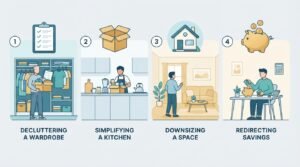
Step 1: Declutter One Category at a Time
Start with one area — a closet, a kitchen drawer, a bookshelf. Remove what you do not use, need, or love. Notice how it feels to have less in that one space. The experience usually motivates the next area.
Step 2: Apply the 30-Day Rule Before Buying
When you want to buy something non-essential, wait 30 days. If you still want it and it fits your budget, buy it. Often, the desire fades within a week. This single habit prevents most impulse purchases — see our guide on how to build a healthy relationship with money for more on managing spending impulses.
Step 3: Buy Fewer, Better Things
Instead of buying three cheap items that wear out, buy one quality item that lasts. This often costs less over time, even though the initial purchase is higher. Quality over quantity is the minimalist spending principle in one sentence.
Step 4: Question Every Recurring Cost
Subscriptions and memberships are the stealth budget-killers. Apply the minimalist filter: do I use this regularly and value it enough to keep paying? If not, cancel it. Every recurring cost you remove is permanent monthly savings.
Step 5: Let Spaces Stay Simple
Once you declutter a space, resist the urge to refill it. An empty shelf is not a problem to solve — it is space and money saved. The habit of keeping spaces simple is what prevents the clutter from returning.
Step 6: Redirect the Savings
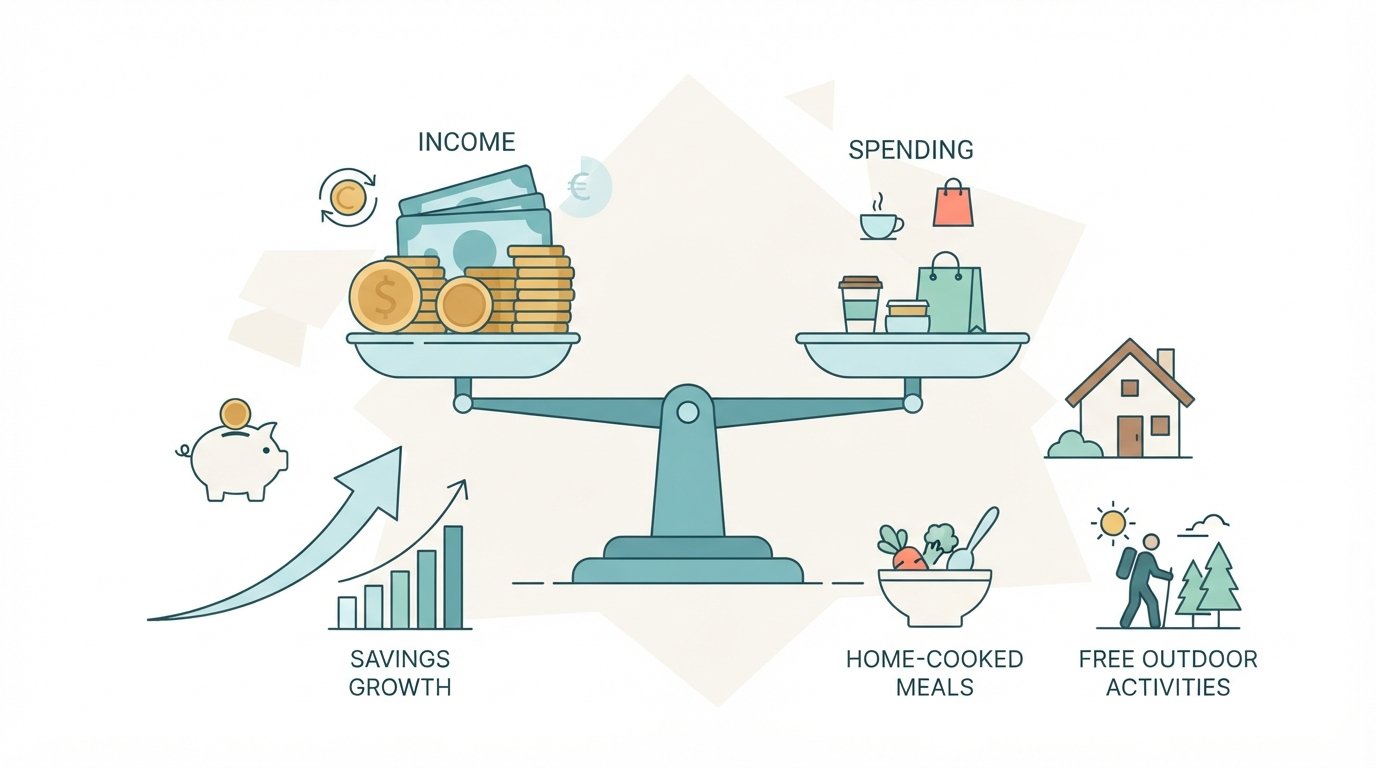
Every dollar not spent on stuff is a dollar available for savings, debt reduction, or financial independence. Make the redirect intentional — move the money to a savings or investment account so it does not quietly disappear into other spending.
The Mindset Shift: From More to Enough
The financial mechanics of minimalism are straightforward. The harder part — and the more important part — is the mindset shift that makes it last.
Enough Is a Decision, Not a Number
There is no universal definition of “enough.” It is a personal decision about what level of comfort, possessions, and lifestyle satisfies you. Minimalism helps you discover your own enough by removing the noise of excess and focusing on what genuinely adds value.
Comparison Fuels Consumption
Much of what we buy is driven by comparison — what others have, what advertising tells us we need, what social media suggests is normal. Minimalism reduces the power of comparison by shifting the focus from acquiring to appreciating. See our guide on anti-consumerism and money for more on how reducing consumption increases satisfaction.
Owning Less Is Not Losing — It Is Gaining
When you let go of items you do not use, you are not losing something. You are gaining space, time, money, and mental clarity. Reframing decluttering as a gain rather than a loss makes the practice feel positive rather than sacrificial.
Freedom Is the Ultimate Goal
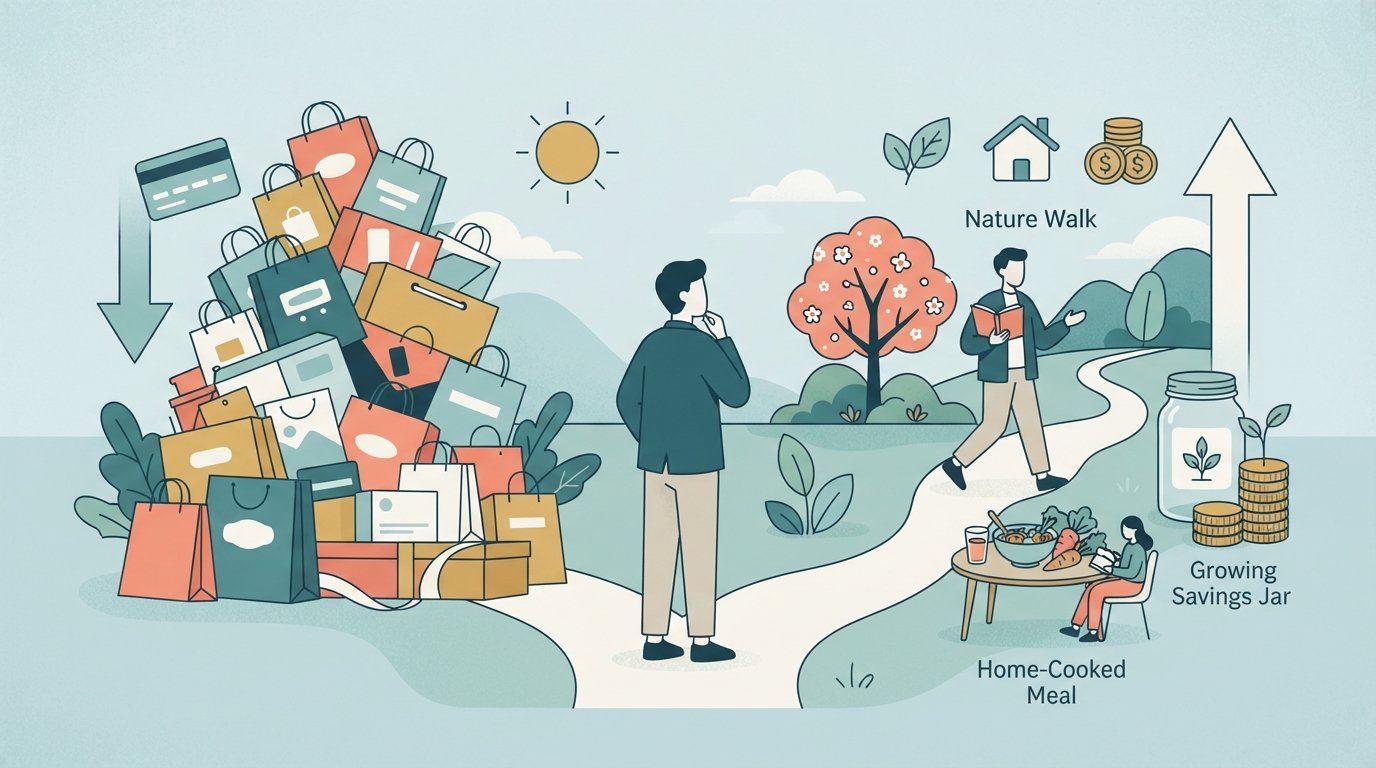
The point of minimalist spending is not to have an empty home. The point is to have a life directed by your values rather than by your possessions. Every item you do not buy is money available for the things that matter more — whether that is travel, time with family, giving, or financial independence.
Real-World Example: How One Household Saved by Owning Less
Consider a household that applies minimalism across three categories over one year.
Clothing:
They declutter their wardrobe, keeping only items they wear regularly. They stop buying trend-driven clothing and invest in a smaller number of versatile, durable pieces. Clothing spending drops from $1,800 per year to $600 — a savings of $1,200.
Storage and housing:
They cancel a $90-per-month storage unit they were using for items they rarely accessed. They declutter the items and do not replace the storage. Savings: $1,080 per year.
Subscriptions and gadgets:
They cancel four unused or barely-used subscriptions totaling $45 per month and stop buying kitchen gadgets they never use, saving roughly $300 per year. Savings: $840 per year.
Total savings from minimalism in one year: $3,120 — redirected to an emergency fund and investments, with no decrease in quality of life. In fact, the household reports feeling less stressed and more in control, not deprived.
The point is not the exact amounts. It is that the savings came from owning less, not from earning more — and that the lifestyle change felt like a gain, not a loss.
Common Minimalism and Money Mistakes to Avoid
- Treating minimalism as a one-time purge: Decluttering once is a start, but minimalism is an ongoing practice. The goal is to change how you acquire, not just how you discard.
- Buying “minimalist” products to look minimalist: Buying expensive minimalist-branded items defeats the purpose. Minimalism is about owning less, not about buying different stuff.
- Going too extreme too fast: Selling everything in a week feels productive but is often unsustainable. Gradual change sticks better.
- Confusing minimalism with cheapness: Minimalism is about value, not the lowest price. A quality item that lasts years can be more minimalist than three cheap items that break.
- Not redirecting the savings: If the money you save from owning less gets spent on other things, you have changed your clutter but not your finances. Direct the savings intentionally.
- Judging others’ choices: Minimalism is personal. What is excess to you may be valuable to someone else. Focus on your own enough.
- Forgetting that experiences matter more than things: The money saved from owning less is best directed toward experiences, relationships, and freedom — not toward different categories of stuff.
- Expecting instant life transformation: Minimalism improves life gradually. The benefits compound over time, not overnight.
Frequently Asked Questions
What is the connection between minimalism and money?
Every item you own costs money to buy, maintain, store, clean, insure, and replace. Owning fewer things reduces all of these costs. Minimalism is a financial strategy because it directly lowers spending across nearly every category of a household budget.
How does minimalism save money?
Minimalism saves money by reducing the purchase price of items, lowering maintenance and storage costs, cutting subscription and recurring expenses, reducing the amount of space you need, and preventing impulse purchases. The savings compound across categories and over time.
Do I have to own very little to be a minimalist?
No. Minimalism is not about a specific number of possessions. It is about owning only what adds value to your life. A minimalist may own many tools if they use them, or many books if they read them. The intention behind ownership matters more than the count.
Is minimalist living on a budget just being cheap?
No. Cheap means always choosing the lowest price, often at the cost of quality. Minimalism means choosing value — which may mean buying fewer, higher-quality items that last longer. The financial effect is often lower total cost, but the principle is intention, not cheapness.
How do I start minimalism if I have a full house?
Start with one category — a closet, a drawer, a room. Remove what you do not use, need, or love. Notice how the simpler space feels, then move to the next area. Gradual decluttering is more sustainable than a dramatic one-time purge.
Will minimalism make me happier?
For many people, yes — but not because of the aesthetics. Minimalism reduces stress, decision fatigue, and financial pressure, while increasing space, time, and money for what matters. The happiness comes from the freedom, not from the empty shelves.
How does minimalism connect to financial independence?
Minimalism lowers your expenses, which increases your savings rate and reduces the portfolio size you need for financial independence. Lower expenses mean you can save more and reach your FI number sooner. See our guide on financial independence for beginners for the full framework.
Can a family practice minimalism?
Yes. Family minimalism looks different from solo minimalism — children need toys, schools require supplies, and households accumulate more — but the principles still apply. Fewer, better toys; intentional clothing; shared spaces; and a focus on experiences over things all work for families.
Key Takeaways
- Minimalism is not about empty rooms — it is about owning only what adds value and removing what does not.
- Every possession carries hidden costs: maintenance, storage, cleaning, insurance, replacement, and depreciation.
- Minimalism reduces spending across nearly every budget category, especially housing, clothing, storage, and subscriptions.
- Start gradually: declutter one area at a time, apply the 30-day rule before buying, and buy fewer, better things.
- The mindset shift is from “more” to “enough” — defining satisfaction on your own terms rather than through comparison.
- Redirect the savings intentionally toward goals, not toward different categories of spending.
- Minimalism is not cheapness — it is value-based spending that often costs less over time.
- The ultimate goal is freedom: less money tied up in stuff means more available for what matters.
- Family minimalism is possible and practical — the principles adapt to any household.
To continue exploring the lifestyle behind financial independence, read our guide on anti-consumerism and money for how reducing consumption increases satisfaction, and our pillar guide on financial independence for beginners for how this fits into the FIRE framework. For the mindset that supports intentional spending, see how to build a healthy relationship with money.
Minimalism is not about having less — it is about having room for more of what matters. Every item you do not own is money, time, and space returned to you. Own less, save more, and direct the difference toward a life you actually chose.
This article is for informational purposes only and is not financial advice. Budgeting needs and lifestyle preferences vary by individual and household.


2 thoughts on “Minimalism and Money: How Owning Less Saves You More”