








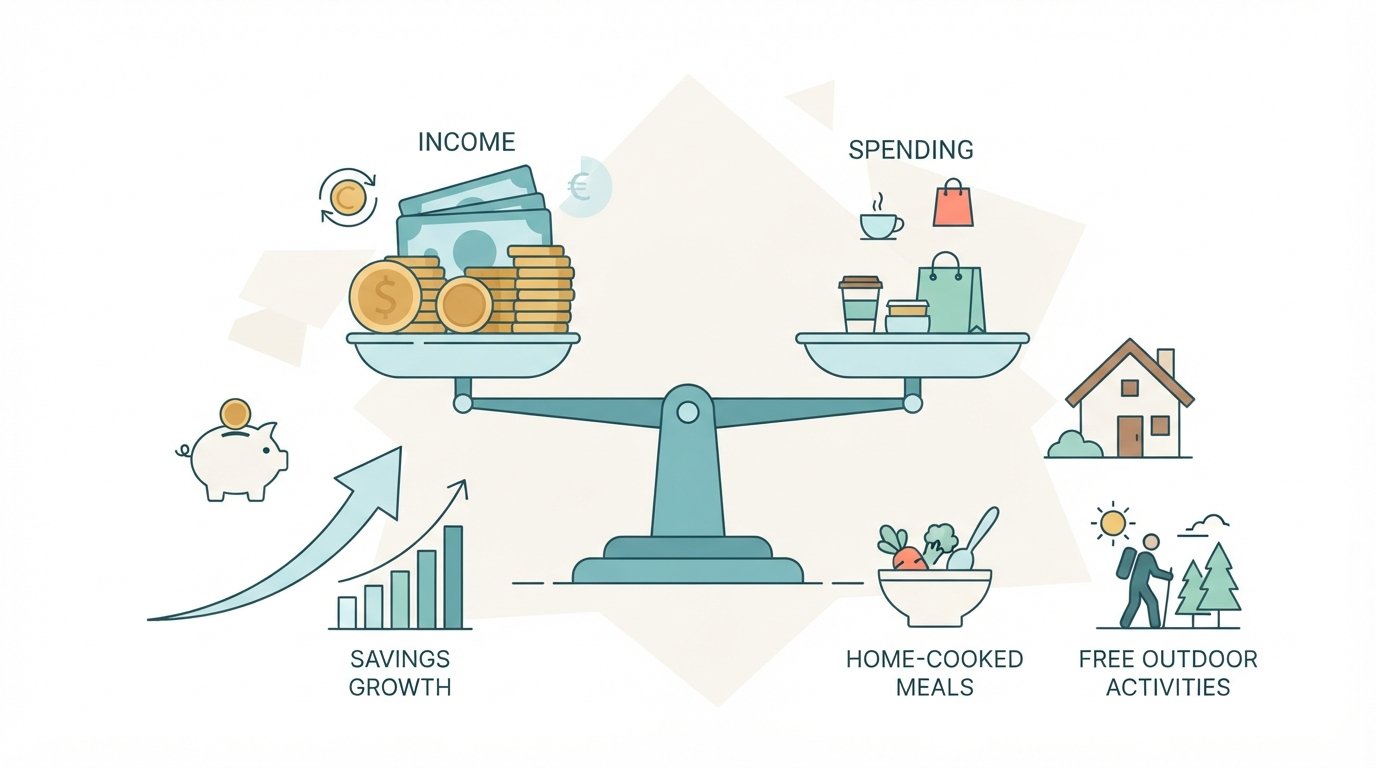
“Live below your means” is some of the most common financial advice you will ever hear. It is also some of the least explained.
Most people understand the idea: spend less than you earn. But far fewer know how to actually do it in a way that lasts — without feeling like every day is a exercise in self-denial. That is why so many people try to cut spending, hold it together for a few weeks, and then rebound into overspending because the restriction felt unbearable.
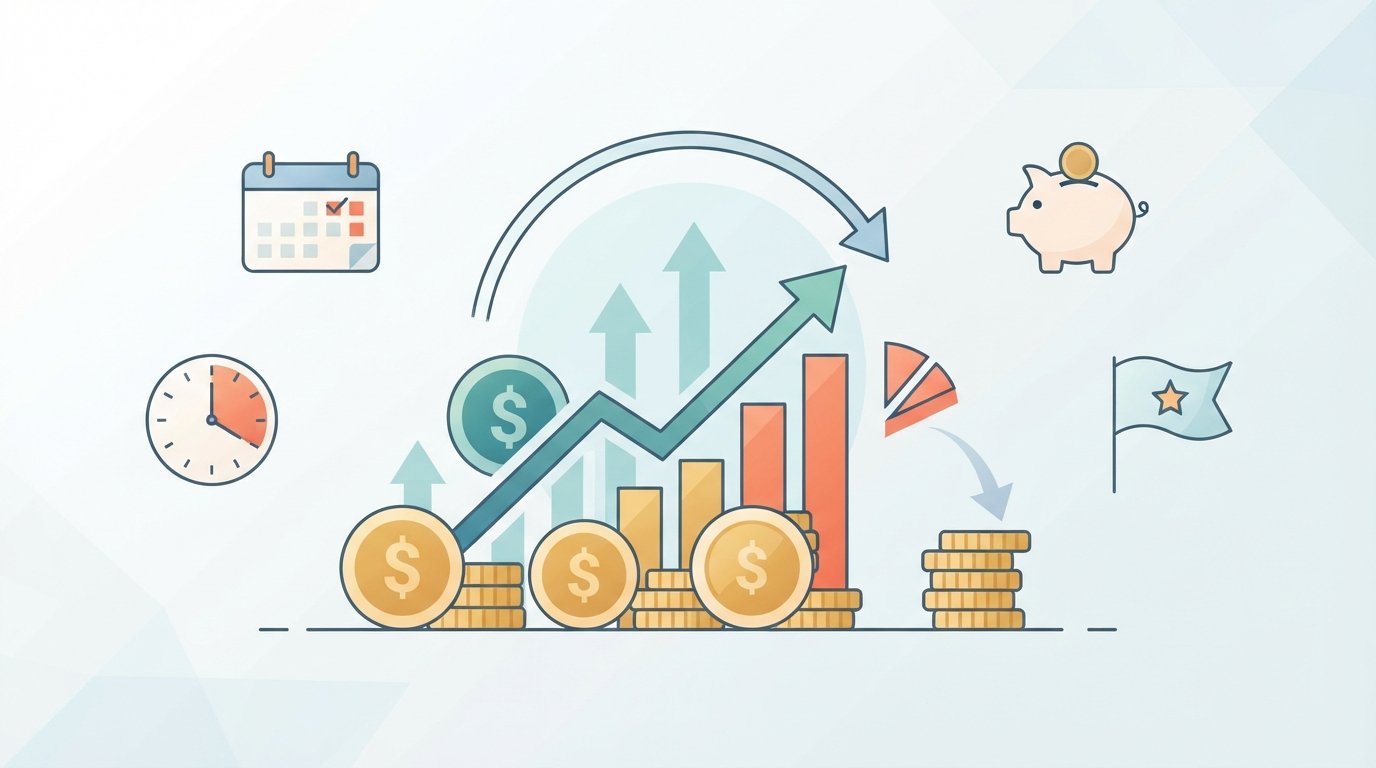
Learning how to live below your means is not about shrinking your life to the smallest possible footprint. It is about building a sustainable gap between what you earn and what you spend — a gap that grows your savings, reduces your financial stress, and creates the foundation for financial independence. The living below your means tips in this guide are designed to be practical, not punishing, and they pair naturally with simple living on a budget as a long-term lifestyle.
If you are pursuing financial independence, this is the engine that drives it. Start with our pillar guide on financial independence for beginners for the full framework, then return here for the practical spending side.
What “Living Below Your Means” Actually Means
Living below your means means spending less than you earn consistently — not occasionally, and not only when it is convenient. It means your lifestyle costs less than your income produces, and the difference is directed toward savings, investments, or debt reduction.
It Is Not the Same as Being Frugal
Frugality is about finding the cheapest option. Living below your means is about finding the right option for your budget. A frugal person might drive the cheapest car possible; a person living below their means might drive a reliable, modest car that fits comfortably within their income. The distinction matters because deprivation-driven frugality rarely lasts, while income-aligned spending does.
It Is Not About Minimum Spending — It Is About Intentional Spending
The goal is not to spend as little as humanly possible. The goal is to spend intentionally on what matters and to cut what does not. Someone living below their means might spend generously on a passion or priority and very little on categories they do not care about. The gap is what matters, not the individual categories.
It Is a Habit, Not a One-Time Cut
Living below your means is not a crash diet for your finances. It is a permanent lifestyle adjustment — a way of aligning your spending with your income and your values, month after month. The sustainability is what makes it powerful.
Why Most People Fail at Living Below Their Means
Understanding the common failure points helps you avoid them.
Lifestyle Creep
As income rises, spending rises to match it. A promotion leads to a bigger apartment, a newer car, more expensive habits. The gap between income and spending stays the same or even shrinks, even though earnings grew. Living below your means requires resisting this drift — see our guide on frugal living 101 for strategies that keep spending in check as income grows.
Emotional and Social Spending
Much overspending is not about needs — it is about emotions and social pressure. Stress, boredom, celebration, and comparison all drive purchases that have nothing to do with what we actually value. Recognizing these triggers is the first step to managing them.
Unclear Spending
When you do not know where your money goes, you cannot control it. Most people underestimate their spending by a significant margin, especially in categories like food, subscriptions, and small daily purchases that add up over a month.
All-or-Nothing Thinking
Many people attempt to cut everything at once, feel deprived within weeks, and quit. Sustainable spending changes happen gradually — one category at a time — so the adjustment feels natural rather than punishing.
Step 1: Know Your Numbers
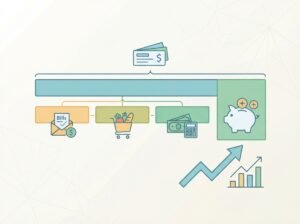
You cannot live below your means if you do not know what your means are. The first step is full visibility.
Calculate Your After-Tax Income
Use your actual take-home pay — the amount that lands in your account after taxes and deductions. This is the real number you have to work with, not your headline salary.
Track Every Expense for One Month
For one full month, record every purchase — every bill, every coffee, every subscription, every cash transaction. Group them into categories. Most people are surprised by at least one category when they see the real total.
Identify Your Current Gap
Subtract your total monthly spending from your monthly income. If the number is positive, you are already living below your means — the goal is to grow that gap. If the number is zero or negative, you are living at or above your means, and the first priority is creating a gap, however small.
Step 2: Cut the Big Three First
Small savings matter, but the biggest impact comes from the three largest expense categories for most households: housing, transportation, and food.
Housing
Housing is usually the largest single expense. Options to reduce it include living in a smaller space, house-hacking (renting a room or unit to offset costs), moving to a lower-cost area, or refinancing if rates make sense. Even a 10% reduction in housing costs can free up hundreds per month.
Transportation
A car is often the second-largest expense. Driving an older, reliable vehicle instead of upgrading, buying used rather than new, reducing to one vehicle per household, or using public transit can each save significant amounts. The key is to separate transportation needs from status desires.
Food
Food is the most flexible large expense. Cooking at home more often, reducing takeout and delivery, planning meals to reduce waste, and buying staples in bulk can cut a food budget by 30% or more without reducing quality. See our guide on frugal living 101 for detailed grocery strategies.
Step 3: Eliminate the Silent Spending
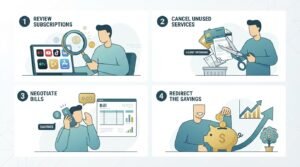 Beyond the big three, many households lose money to subscriptions, fees, and small recurring costs they barely notice.
Audit Your Subscriptions
List every subscription and recurring payment — streaming services, apps, gym memberships, boxes, clubs. Cancel anything you have not used in the last 30 days. For the ones you keep, consider whether a cheaper tier or a shared plan would work.
Negotiate Recurring Bills
Internet, phone, and insurance bills can often be reduced by calling the provider and asking for a better rate or switching to a competitor. Many people never try and end up overpaying for years.
Reduce Fees
Bank fees, late fees, overdraft fees, and ATM fees are pure waste. Switching to a no-fee account, setting up automatic payments, and keeping a small buffer in checking can eliminate these entirely.
Track Small Daily Spending
A $5 coffee or a $15 lunch is not a problem in isolation. But $5 per day is $1,800 per year. You do not have to eliminate these — just be aware of them and decide intentionally whether they are worth it to you.
Step 4: Align Spending With Values
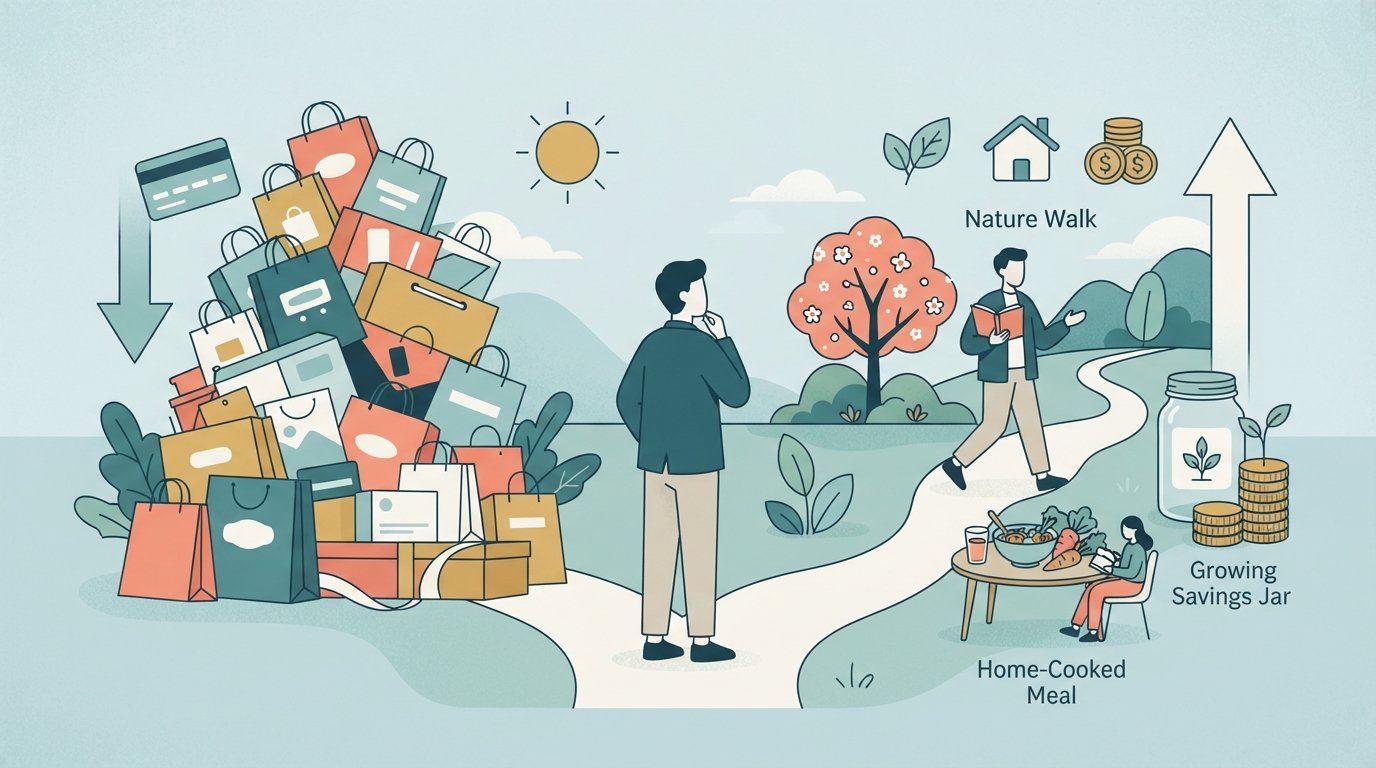
This is the step that turns living below your means from a restriction into a sustainable lifestyle. Instead of cutting everything, you spend generously on what matters and ruthlessly cut what does not.
Identify Your Top Three Spending Priorities
What brings you the most genuine value? It might be travel, health, time with family, a hobby, or education. These are the categories where you should feel comfortable spending — because they align with what you care about.
Cut Mercilessly From the Rest
For categories that do not align with your values, cut aggressively. If you do not care about fashion, spend minimally on clothing. If you do not care about cars, drive something modest. The money saved from low-priority categories funds both your high-priority ones and your savings goals.
Use the “Hour of Life” Test
Before a purchase, calculate how many hours of work it costs. If a $200 item costs you five hours of work, ask: is this worth five hours of my life? This reframing — from price to time — often changes the answer. It is one of the core ideas behind minimalism and money, which explores how owning less directly leads to saving more.
Step 5: Grow the Gap Over Time
Living below your means is not a one-time achievement — it is a practice that strengthens over time.
Increase Income and Keep Spending Flat
The most powerful way to grow the gap is to increase your income while keeping your spending the same. A raise, a side hustle, or a new job that adds income — directed entirely to savings — grows the gap without requiring any new sacrifice. This is the opposite of lifestyle creep.
Automate Your Savings
Set up an automatic transfer to savings or investments the day your paycheck arrives. If the money moves before you can spend it, living below your means becomes the default rather than a monthly effort.
Review and Adjust Quarterly
Every three months, review your spending. Are there new subscriptions? Has any category crept upward? Has your income changed? A quick quarterly check keeps the gap healthy without requiring constant attention.
Celebrate the Progress
Living below your means is not about suffering in silence. When you hit a savings milestone, acknowledge it. The gap you have created is real financial progress — and it is the foundation of everything from an emergency fund to financial independence.
Real-World Example: Growing the Gap Without Deprivation
Consider a single earner making $4,000 per month after tax and spending $3,800 — a gap of only $200.
Step 1 — Tracking:
They track spending for one month and discover they are spending $600 on takeout and restaurants, $180 on subscriptions (several unused), and $120 on ride-sharing they could replace with public transit.
Step 2 — Cuts that do not hurt:
They cancel $80 of unused subscriptions, reduce takeout from $600 to $300 by cooking three more meals per week, and use transit for most trips, saving $80. Total savings: $260 per month. New gap: $460.
Step 3 — Value-aligned spending:
They redirect $100 of the savings to a travel fund — something they genuinely value — and put $360 toward savings and investments. Their lifestyle has not shrunk; it has shifted. They still eat out, just less often. They still travel, just with a plan.
Step 4 — Income increase:
Six months later, they get a raise of $300 per month. Instead of expanding spending, they direct the entire raise to investments. New gap: $760 per month — nearly four times where they started, with no increase in deprivation.
The point is not the exact numbers. It is the process: visibility, targeted cuts, value-aligned spending, and directing income growth to the gap.
Common Mistakes to Avoid
- Cutting everything at once: All-or-nothing cuts lead to rebound spending. Change one category at a time.
- Focusing only on small savings: Negotiating your phone bill matters, but housing and transportation matter more. Start with the big three.
- Ignoring silent spending: Subscriptions and fees drain money quietly. Audit them regularly.
- Confusing deprivation with discipline: If your spending plan makes you miserable, it will not last. Align spending with your values instead.
- Letting lifestyle creep close the gap: Raises should grow the gap, not the spending. Direct income growth to savings.
- Not automating savings: If you rely on willpower to save what is left, there will rarely be anything left. Automate the transfer.
- Comparing your spending to others: What looks like a normal lifestyle to your social circle may be above your means. Define enough for yourself.
- Treating it as a temporary project: Living below your means is a permanent lifestyle, not a financial crash diet.
Frequently Asked Questions
What does it mean to live below your means?
It means consistently spending less than you earn, so that there is a gap between your income and your spending that can be directed toward savings, investments, or debt reduction. The gap — not the individual cuts — is the goal.
How do I start living below my means?
Start by tracking every expense for one month to see where your money goes. Calculate your after-tax income, identify your current gap, and then target the biggest spending categories first — usually housing, transportation, and food. Cut gradually, one category at a time, so the changes are sustainable.
How much below my means should I live?
There is no single number, but a common target is a savings rate of at least 20% of your after-tax income. If you are pursuing financial independence, a higher rate — 30% to 50% or more — accelerates the timeline. The right amount is one you can sustain without feeling deprived.
How can I live below my means without feeling deprived?
Align your spending with your values. Spend generously on what matters most to you and cut aggressively from what does not. Use the “hour of life” test to evaluate purchases, and redirect income growth to savings rather than lifestyle expansion. See our guide on minimalism and money for how owning less can increase satisfaction.
What are the biggest expenses to cut first?
For most households, the three largest categories are housing, transportation, and food. Reducing any of these has more impact than cutting small expenses. Start with the big three, then move to subscriptions and fees.
How do I stop lifestyle creep?
When your income increases — through a raise, bonus, or side income — direct the entire increase to savings or investments rather than expanding your spending. Automate the transfer so the new money never enters your everyday spending account.
Should I live below my means if I have debt?
Yes. Living below your means creates the gap you need to pay down debt faster. Clearing high-interest debt should be the first priority for the gap you create, because debt interest works against everything else.
How does living below my means connect to financial independence?
The gap between your income and spending is the engine of financial independence. The larger the gap, the more you can save and invest, and the lower the expenses your portfolio eventually needs to cover. See our guide on financial independence for beginners for the full framework.
Key Takeaways
- Living below your means means consistently spending less than you earn — and directing the gap toward savings and goals.
- It is not about minimum spending; it is about intentional spending aligned with your values.
- Start with full visibility: track your income and expenses, and identify your current gap.
- Target the big three — housing, transportation, and food — before focusing on small cuts.
- Eliminate silent spending: audit subscriptions, negotiate bills, and reduce fees.
- Spend generously on your top priorities and cut mercilessly from what you do not care about.
- Grow the gap over time by directing income increases to savings rather than lifestyle expansion.
- Automate your savings so living below your means becomes the default, not a monthly effort.
- This is a permanent lifestyle, not a temporary project — sustainability matters more than intensity.
To continue building the lifestyle that supports financial independence, read our guides on minimalism and money and frugal living 101. For the full FIRE framework and how this spending discipline fits into it, see our pillar guide on financial independence for beginners.
Living below your means is not about having less — it is about keeping more of what you earn, spending it on what actually matters to you, and building a gap that buys back your freedom one month at a time.
This article is for informational purposes only and is not financial advice. Budgeting needs and income levels vary by individual and household.


One thought on “How to Live Below Your Means (Without Feeling Deprived)”