







Most people work for decades with the same plan: earn, spend what you need, save a little, retire around sixty-five, and hope the savings last. It is a plan that works for some, but it also assumes you want to spend forty-plus years trading time for money before you get to choose how to spend your days.
There is another approach — one that has grown into a global movement over the last decade. It is called FIRE, which stands for Financial Independence, Retire Early, and it is built on a simple idea: if you spend less than you earn and invest the difference consistently, you can reach a point where work becomes a choice rather than a necessity, often years or decades before the traditional retirement age.
This guide is financial independence for beginners. It explains what is FIRE movement in plain language, covers how to reach financial independence without extreme deprivation, and walks through the core ideas, the math, and the lifestyle that make it work. No finance degree required — just a willingness to think differently about money, time, and what enough means to you.
If you are new to money management altogether, this guide builds on the foundations in our guide on how to build a healthy relationship with money. If you already budget and save, this is the next level — the framework that turns good habits into freedom.
What Is the FIRE Movement?
FIRE stands for Financial Independence, Retire Early. It is a lifestyle and financial approach built on one core principle: save and invest a high percentage of your income so that your investments eventually generate enough to cover your living costs — at which point working becomes optional.
Financial Independence
Financial independence means having enough income from investments and assets to cover your essential living expenses without needing to work. You may choose to work, but you are no longer forced to. The key word is “choose.”
Retire Early
“Retire early” does not necessarily mean stopping work at thirty-five and sitting on a beach. For most people in the FIRE movement, it means reaching the point where you have the freedom to choose — whether that means continuing your career, switching to part-time, starting a passion project, volunteering, or stepping away from paid work entirely.
The Core Trade-Off
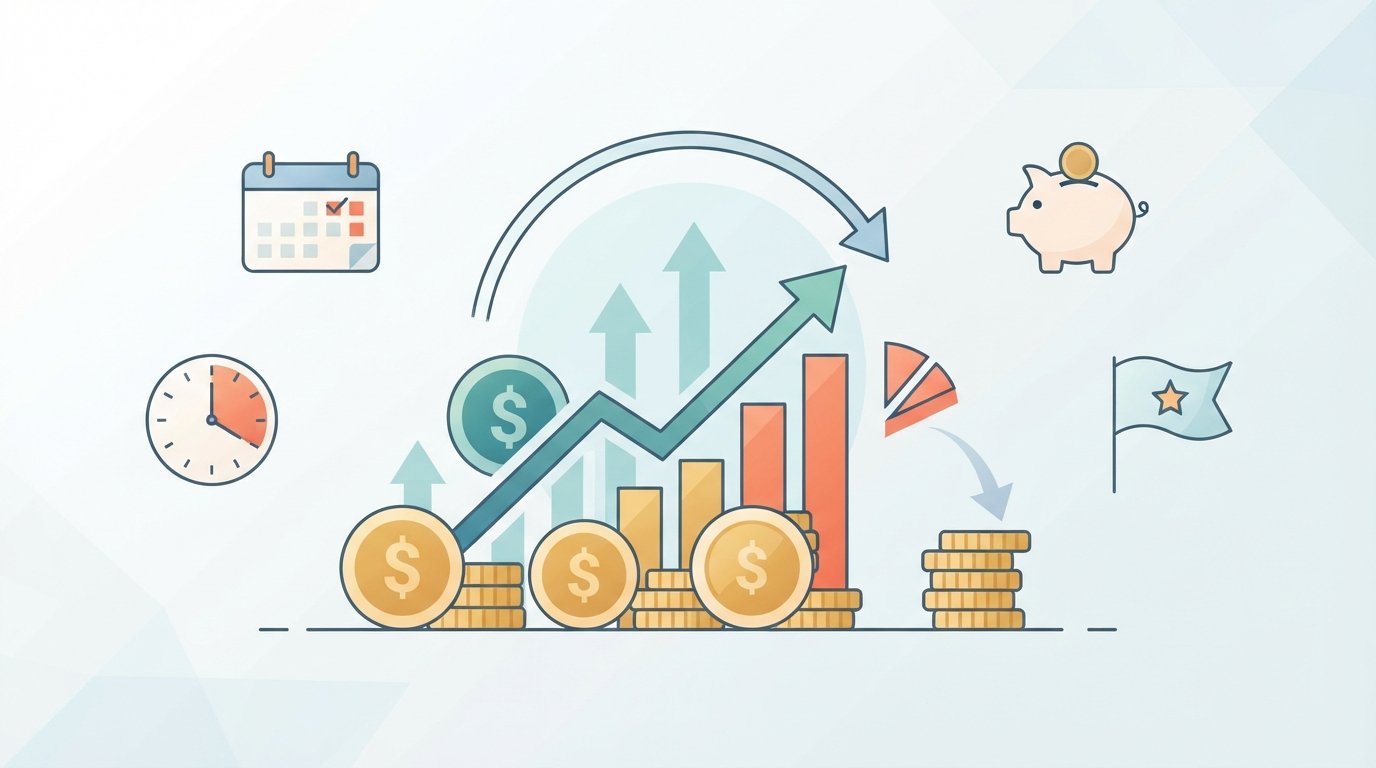
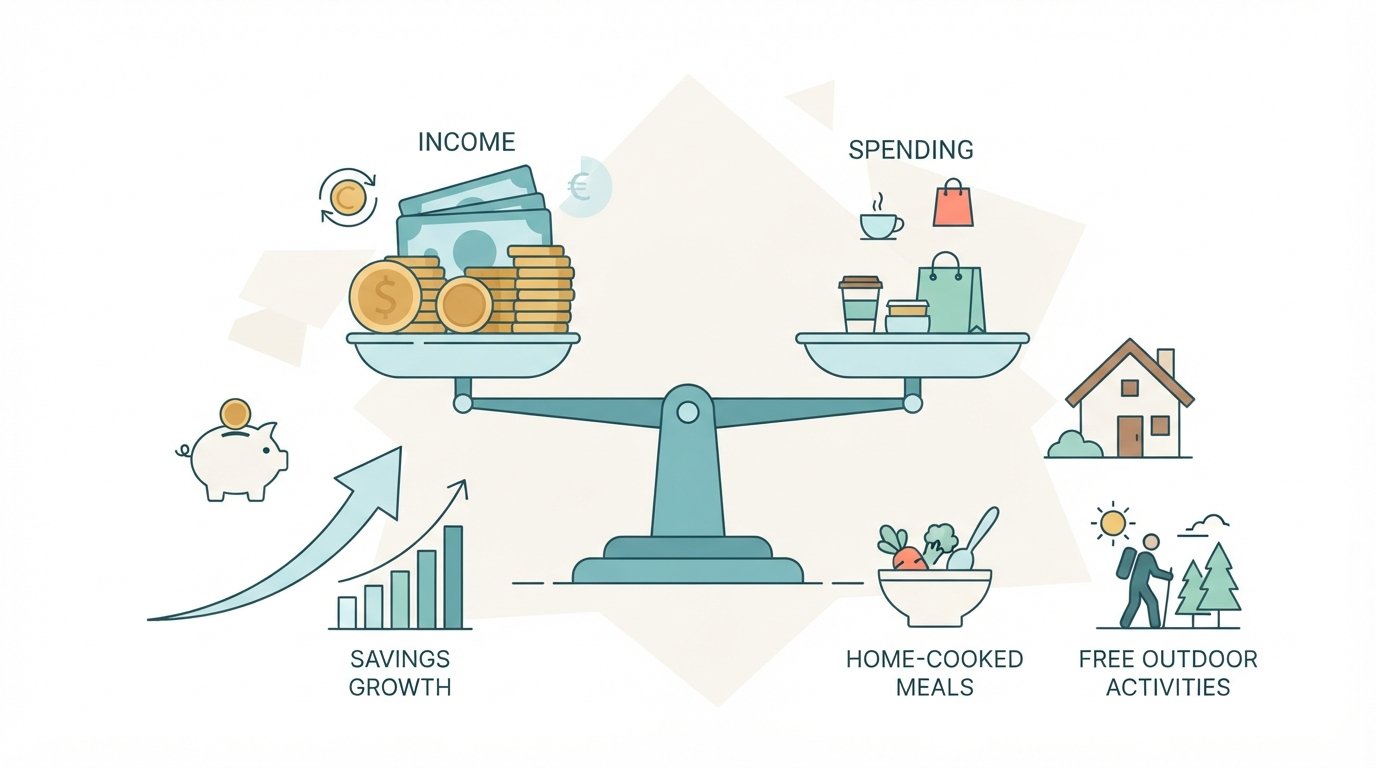
FIRE is a trade-off: you live on less now so that you can have freedom sooner. The more you save and the less you spend, the faster you reach independence. The less you save and the more you spend, the longer you work. Everything in FIRE flows from that single relationship.
How Financial Independence Works: The Core Math
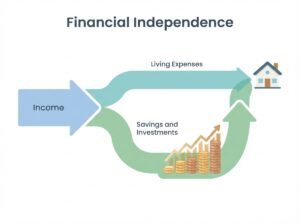
The math behind FIRE is simpler than most people expect. It comes down to three numbers: your income, your expenses, and your savings rate.
Your Savings Rate Is the Key
Your savings rate is the percentage of your income that you save and invest. It is the single most important number in FIRE because it determines how long it takes to reach independence.
| Savings Rate | Approximate Years to Financial Independence |
|---|---|
| 10% | 51 years |
| 20% | 37 years |
| 30% | 28 years |
| 40% | 22 years |
| 50% | 17 years |
| 60% | 12 years |
| 70% | 9 years |
These are approximations based on the assumption that you invest the savings and earn a reasonable long-term return after inflation. The key takeaway: doubling your savings rate does not halve your time to independence — it reduces it even more, because you are both saving more and needing less.
Why Spending Matters More Than Income
A higher income helps, but spending is the more powerful lever. If you earn $100,000 and spend $95,000, you save 5% and need decades. If you earn $60,000 and spend $30,000, you save 50% and need roughly 17 years. The person who earns less but spends less reaches independence faster — because they need a smaller portfolio to cover their expenses.
This is why how to reach financial independence is less about earning more and more about spending intentionally. See our guide on how to live below your means for the practical side of this principle.
The FI Number
Your FI (financial independence) number is the portfolio size at which your investments can safely cover your annual living expenses. A common guideline is to multiply your annual expenses by 25 — so if you spend $40,000 per year, your FI number is roughly $1,000,000. This is connected to the 4% rule, which we explain in detail in our guide on what is the 4% rule.
The Three Stages of FIRE
FIRE is not a single leap from working to freedom. It is a gradual journey with distinct stages, each with its own focus.
Stage 1: Debt Reduction and Foundation
Before building wealth, eliminate high-interest debt. Credit card debt, personal loans, and other high-cost borrowing work against everything FIRE stands for — you cannot invest your way to freedom while paying 20% interest on a balance. Focus on clearing debt and building a basic emergency fund first.
Stage 2: Accumulation
This is the longest stage. You save and invest aggressively, keep expenses low, and let compound growth work over time. The early years feel slow, but as the portfolio grows, the growth accelerates. During this stage, the focus is on increasing your savings rate and staying consistent.
Stage 3: Financial Independence
When your portfolio reaches your FI number, you have theoretically reached independence. At this point, your investments can cover your living expenses, and work becomes a choice. Some people stop working entirely; others shift to work they enjoy, reduce hours, or pursue passion projects. The point is that the choice is theirs.
The Lifestyle Behind the Math

FIRE is not just about math. It is also about a different relationship with spending, possessions, and status. The lifestyle side is what makes the math sustainable.
Spending Intentionally, Not Minimally
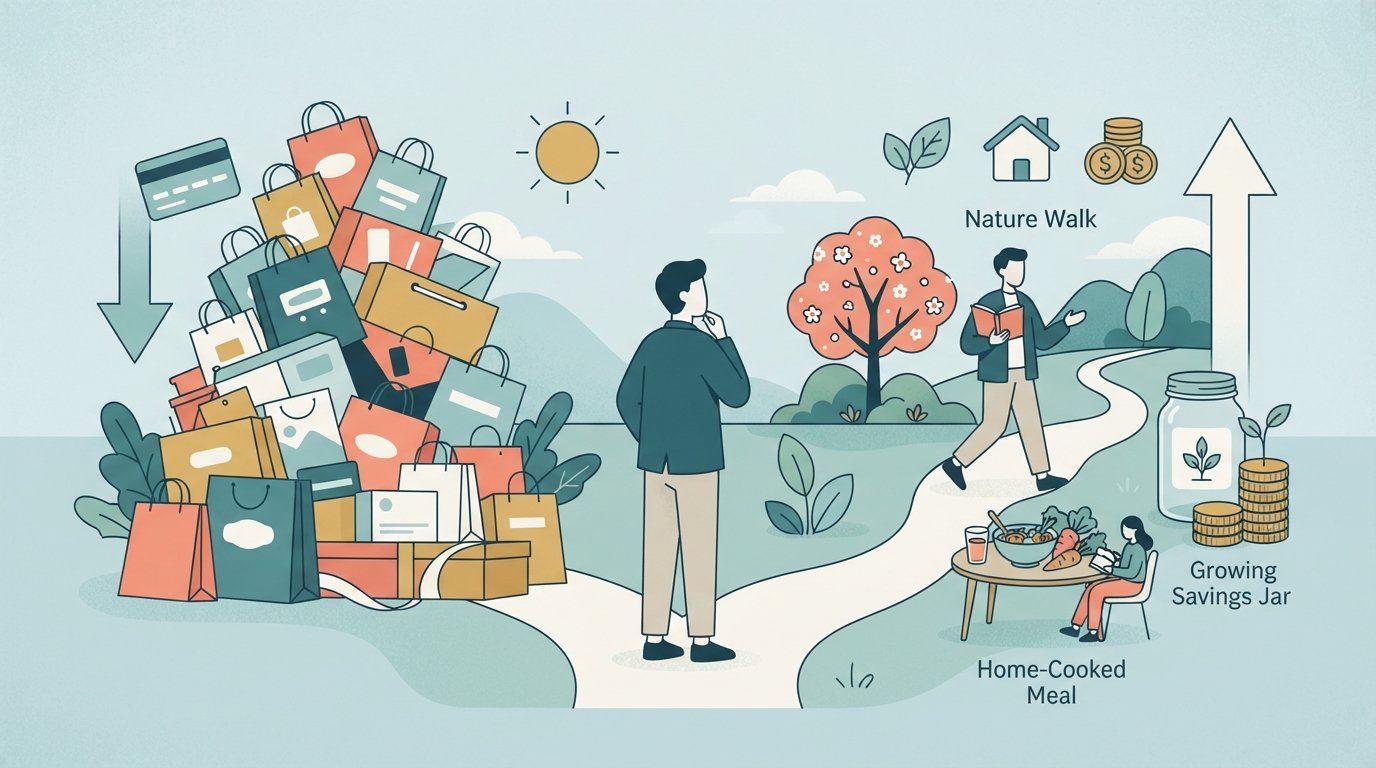
People pursuing FIRE are not necessarily frugal in every area. They spend intentionally on what matters and cut aggressively on what does not. The goal is not to spend as little as possible — it is to spend on what brings genuine value and to redirect the rest toward freedom.
Valuing Time Over Things
FIRE reframes the relationship between money and time. Instead of asking “can I afford this?” the question becomes “how many hours of my life does this cost, and is it worth that?” This shift changes how you view every purchase. See our guide on anti-consumerism and money for more on this mindset.
Owning Less
Minimalism and FIRE are natural partners. Owning fewer things means spending less on buying, maintaining, storing, and replacing them. A smaller home, fewer possessions, and simpler living all reduce the amount you need to save to be free. See our guide on minimalism and money for how owning less directly saves more.
Avoiding Lifestyle Creep
As income grows, the temptation is to spend more. FIRE requires the opposite: as income grows, savings grow, and spending stays roughly the same. This is the opposite of lifestyle creep, and it is what accelerates the path to independence.
Common FIRE Approaches
FIRE is not one-size-fits-all. Different people pursue it at different intensities, and there is no single “right” way.
| FIRE Type | Description | Best For |
|---|---|---|
| Lean FIRE | Minimal expenses, very high savings, freedom on a small portfolio | People willing to live very simply |
| Standard FIRE | Moderate savings, moderate expenses, freedom on a typical portfolio | Most people seeking balance |
| Fat FIRE | Higher income, higher savings, freedom with a larger lifestyle | High earners who want comfort |
| Barista FIRE | Partial savings, partial freedom — work part-time to cover some expenses | People who want a middle path |
| Coast FIRE | Save enough early that it grows to cover retirement without further contributions | People who want to stop saving but keep working |
The right approach depends on your income, your desired lifestyle, and how much freedom you want versus how much you enjoy your work. There is no universal answer — only the answer that fits your life.
How to Start Pursuing Financial Independence
If FIRE appeals to you, here is how to begin — no matter your income or starting point.
Step 1: Track Your Spending
You cannot pursue FIRE without knowing exactly where your money goes. Track every dollar for one to three months, categorize your spending, and identify where your money is going. This is the foundation everything else is built on.
Step 2: Calculate Your Current Savings Rate
Divide what you save and invest each month by your monthly income. This number tells you where you are today and gives you a baseline to improve. Even 10% is a start — the goal is to increase it over time.
Step 3: Reduce Expenses Intentionally
Look at your spending categories and identify where you can cut without sacrificing genuine quality of life. Focus on the biggest categories first — housing, transportation, and food — where reductions have the most impact. See our guide on frugal living 101 for practical strategies.
Step 4: Increase Income if Possible
Cutting expenses has limits; increasing income does not. A side hustle, a career change, or a promotion that you direct entirely to savings can dramatically accelerate your timeline. The key is to resist the temptation to spend the extra income — direct it to investments instead.
Step 5: Invest Consistently
Saving is not enough — the money needs to be invested to grow. Low-cost index funds are the most common FIRE investment because they offer broad diversification at minimal cost. The key is consistency: invest the same amount regularly, regardless of market conditions, and let time do the work.
Step 6: Calculate Your FI Number
Multiply your annual expenses by 25. This gives you a target portfolio size. Knowing this number makes the goal concrete and lets you track your progress as a percentage of your FI number rather than just a vague sense of “saving for the future.”
Real-World Example: A FIRE Journey in Numbers
Consider a 28-year-old earning $55,000 per year after tax, spending $35,000 per year, and saving $20,000 — a savings rate of roughly 36%.
Starting point:
- Annual expenses: $35,000
- FI number (25 × expenses): $875,000
- Current savings: $10,000
- Savings rate: 36%
- Estimated years to FI: roughly 25 years (reaching independence around age 53)
Year 5 — Increased savings rate:
They increase their income to $65,000 through a promotion and side income, but keep spending at $35,000. Savings rate rises to 46%. Portfolio has grown to roughly $130,000 with investment growth. Estimated years to FI drops to roughly 17 more years.
Year 10 — Compound growth kicks in:
Portfolio has grown to roughly $300,000. The investment growth each year is now larger than their annual contributions. The snowball effect is visible. Estimated years to FI: roughly 11 more years.
Year 17 — FI reached:
Portfolio reaches $875,000. At this point, following the 4% guideline, the investments could generate roughly $35,000 per year — enough to cover their expenses. At age 45, they have the choice to continue working, reduce hours, or step away entirely.
The numbers are illustrative and depend on investment returns, which vary year to year. But the principle is real: consistent saving, intentional spending, and patient investing can compress decades of working into a much shorter timeline.
Common FIRE Mistakes to Avoid
- Pursuing FIRE with high-interest debt: Clear expensive debt first — it works against everything else.
- Setting an unrealistically low expense target: If your FIRE budget is too lean to sustain, you will either quit or reach FI and feel deprived.
- Focusing only on cutting, not earning: Increasing income and directing the surplus to savings can be more powerful than cutting alone.
- Ignoring investment basics: FIRE depends on investing, not just saving in a low-interest account. Understand index funds, fees, and diversification.
- Comparing your progress to others: FIRE journeys vary widely by income, expenses, and starting point. Focus on your own savings rate and FI number.
- Sacrificing health or relationships for speed: Extreme saving that harms your wellbeing or family is not success — it is a different kind of cost.
- Forgetting to enjoy the journey: If you are miserable for seventeen years to reach FIRE, the freedom may not feel worth it. Balance matters.
- Assuming returns are guaranteed: Investment returns vary. Plan for a range of outcomes, not a single optimistic scenario.
- Not adjusting your plan over time: Life changes — income, expenses, family, markets. Review your plan annually and adjust.
- Confusing FIRE with never working again: Many FIRE retirees continue to work in some form. The point is choice, not idleness.
Frequently Asked Questions
What is the FIRE movement?
FIRE stands for Financial Independence, Retire Early. It is a lifestyle and financial approach based on saving and investing a high percentage of your income so that your investments eventually cover your living expenses, making work optional — often years or decades before traditional retirement.
How do I reach financial independence?
Reach financial independence by spending less than you earn, investing the difference consistently, and keeping your expenses low enough that a reasonable portfolio can cover them. The higher your savings rate, the faster you reach independence. Start by tracking spending, calculating your savings rate, and increasing it over time.
How much money do I need for financial independence?
A common guideline is to multiply your annual expenses by 25. If you spend $40,000 per year, your target is roughly $1,000,000. This is connected to the 4% rule, which suggests you can withdraw roughly 4% of your portfolio each year to cover expenses. See our guide on what is the 4% rule for details.
Do I need to be rich to pursue FIRE?
No. FIRE is more about your savings rate than your income level. A person who earns less but spends less can reach independence faster than a high earner who spends most of their income. The key is the gap between what you earn and what you spend.
Is FIRE realistic for average earners?
Yes, though the timeline may be longer than for high earners. The principles — spend intentionally, save consistently, invest in low-cost index funds — work at any income level. The savings rate determines the timeline, and even a 20% rate can reach independence in roughly 37 years, which is still earlier than traditional retirement for many.
Do I have to live extremely frugally to pursue FIRE?
Not necessarily. The intensity is up to you. Lean FIRE requires very low expenses, while standard or Fat FIRE allows for a more comfortable lifestyle with a longer timeline. The goal is intentional spending on what matters, not deprivation. See our guide on how to live below your means for a balanced approach.
Can I pursue FIRE with a family?
Yes. Families pursuing FIRE need a household budget that accounts for all family expenses while maintaining a high savings rate. It may take longer, but the principles are the same. See our guide on household budgeting for families for the family-specific framework.
What happens after I reach financial independence?
Whatever you choose. Some people stop working entirely. Others continue working because they enjoy it, shift to part-time, start a passion project, volunteer, or spend more time with family. The point of FIRE is not to stop doing things — it is to have the freedom to choose what you do with your time.
Key Takeaways
- FIRE stands for Financial Independence, Retire Early — the goal is to save and invest enough that work becomes a choice, not a necessity.
- Your savings rate is the most important number: the more you save and the less you spend, the faster you reach independence.
- Spending matters more than income: a lower spender reaches independence faster because they need a smaller portfolio.
- Your FI number is roughly 25 times your annual expenses — this is your target portfolio size.
- FIRE has stages: clear debt first, then accumulate, then reach independence.
- The lifestyle matters as much as the math: intentional spending, valuing time over things, and avoiding lifestyle creep make FIRE sustainable.
- There are different FIRE approaches — lean, standard, fat, barista, and coast — find the one that fits your life.
- Start by tracking spending, calculating your savings rate, and investing consistently in low-cost index funds.
- FIRE is about freedom and choice, not about never working again.
To go deeper, continue with our guides on how to live below your means, minimalism and money, anti-consumerism and money, and what is the 4% rule. For the lifestyle foundations, see our guides on frugal living 101 and how to build a healthy relationship with money.
Financial independence is not about getting rich — it is about buying back your time. Spend intentionally, save consistently, invest patiently, and the freedom to choose how you spend your days becomes not a dream but a plan with a number attached to it.
This article is for informational purposes only and is not financial, investment, or tax advice. Investment returns are not guaranteed and vary based on market conditions. Consult a licensed professional for advice specific to your situation.