










The holidays are supposed to be the most wonderful time of the year. For many families, they are also the most expensive — and the most financially stressful.
Between gifts, food, travel, decorations, parties, and the dozens of small costs that appear throughout the season, holiday spending can easily exceed what a household can afford. The result is a familiar pattern: overspend in December, regret it in January, spend the first few months of the new year paying off credit card balances, and then do it all again twelve months later.
It does not have to work that way. Learning how to budget for the holidays is not about canceling the season — it is about deciding in advance what matters most, assigning money to it, and enjoying the holidays without the financial hangover. A thoughtful holiday spending plan lets you avoid holiday debt and start the new year on solid ground instead of recovering from December.
If you are building this into a broader household money plan, start with our guide on household budgeting for families — holiday spending is one seasonal category within that bigger framework.
Why Holiday Spending Derails So Many Budgets
The holidays are not financially dangerous because people spend too much on a single day. They are dangerous because the spending is spread across weeks, arrives in many small amounts, and is driven by emotions that make rational budgeting difficult.
Spending Is Spread Across Weeks
Holiday spending does not happen in one transaction. It accumulates across November and December — a gift here, groceries there, wrapping paper, a party outfit, a teacher gift, a charitable donation. Each purchase feels small in the moment, but together they add up to a number most families do not realize until the statements arrive in January.
Emotional Spending Is Powerful
The holidays carry emotional pressure. You want loved ones to feel valued. You want your children to have a magical experience. You do not want to be the person who shows up empty-handed. These emotions override logical spending limits, and marketers know it. Every advertisement is designed to make you feel that spending equals love.
Social Comparison Adds Pressure
Seeing what others spend — or appear to spend — pushes budgets higher. Social media amplifies this: elaborate gift hauls, decorated homes, and family trips create a sense that your celebration is inadequate unless it matches. This comparison drives spending that no one actually budgeted for.
Irregular Costs Hit an Already Expensive Month
December often carries other costs: year-end bills, annual insurance premiums, higher utility bills from cold weather, and tax preparation for the year ahead. Holiday spending lands on top of an already heavy month, which is why it so often pushes families into debt.
Step 1: Set a Total Holiday Budget Before the Season Begins
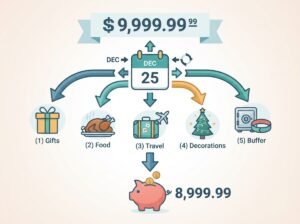
The single most important step in holiday budgeting happens before you buy anything: deciding the total amount you can spend without going into debt.
Decide the Total First
Look at your monthly budget and identify how much you can allocate to holiday spending without borrowing. If you have been saving throughout the year using a sinking fund — a small monthly amount set aside for the holidays — this total is already accumulated. If not, identify what you can spend from current income without carrying a balance into January.
Divide the Total Into Categories
Break your total into specific categories so the money has assigned jobs:
| Category | What It Covers | Typical Share of Budget |
|---|---|---|
| Gifts | Presents for family, friends, teachers, coworkers | 50–60% |
| Food and hosting | Holiday meals, baking, party contributions | 15–20% |
| Travel | Flights, gas, lodging if visiting family | 10–20% |
| Decorations | Tree, lights, wrapping paper, cards | 5–10% |
| Charitable giving | Donations and community contributions | 5–10% |
| Buffer | Unexpected costs and last-minute items | 5–10% |
Your percentages will vary based on your family’s traditions. A family that travels for the holidays will allocate more to travel; a family that hosts will allocate more to food. The point is to assign money to each category before spending begins.
Include a Buffer
Holiday seasons always produce unexpected costs — a last-minute invitation that requires a gift, an ingredient you forgot, a shipping fee you did not anticipate. A small buffer prevents these from blowing the plan.
Step 2: Build a Gift List With Dollar Limits
Gifts are usually the largest holiday expense, and they are the category where spending drifts most. A gift list with assigned dollar amounts keeps this under control.
List Every Recipient
Write down every person you plan to give a gift to — family, friends, teachers, coworkers, service providers. Seeing the full list in one place is often eye-opening. Many families realize their list is longer than they expected, which is the first sign the budget may be too thin.
Assign a Dollar Amount to Each Person
Next to each name, write the maximum amount you will spend. The total of all individual amounts should fit within your gift budget. If it does not, you have two options: reduce the per-person amount or reduce the number of recipients.
Agree on Spending Limits With Extended Family
One of the most effective ways to control holiday gift spending is to agree on limits with extended family. Many families set a per-gift cap, do a name exchange instead of buying for everyone, or agree to give only to children. These conversations can feel awkward, but they often come as a relief — others are feeling the same pressure.
Track Gifts as You Buy Them
As you purchase each gift, write down what you spent next to the recipient’s name. This running tally prevents the most common holiday budgeting mistake: losing track of how much you have already spent and buying more than the plan allows.
Step 3: Save on Food, Travel, and Decorations

Gifts are not the only category where money leaks. Food, travel, and decorations can each add significant cost if they are not planned.
Plan Holiday Meals in Advance
Holiday meals are one of the largest food expenses of the year. Plan the menu early, check what you already have in the pantry, and build a specific shopping list. Buying ingredients across several weeks — when sales appear — spreads the cost and reduces the single-trip sticker shock. If you are hosting, consider asking guests to bring a dish, which reduces both your cost and your stress.
Book Travel Early and Compare Options
If you travel for the holidays, booking early is one of the most reliable ways to save. Flight and lodging prices rise as the holidays approach. Compare driving versus flying, consider traveling on less popular days, and use points or miles if you have them. For more strategies on planning travel costs in advance, see our guide on planning a family vacation on a budget.
Reuse Decorations
Decorations do not need to be new every year. Store them carefully and reuse them. A few new accents — a ribbon, a garland — can refresh the look without replacing the whole collection. If you do buy new, shop the post-holiday clearance for the following year, when prices drop dramatically.
Set Limits on Wrapping and Cards
Wrapping paper, gift bags, and cards add up across a large gift list. Reuse gift bags from previous years, use simple wrapping instead of premium paper, and consider digital cards or a single family photo card rather than individual cards for every recipient. These small savings compound across an entire gift list.
Step 4: Avoid the Debt Trap
The goal of a holiday budget is not just to plan the spending — it is to enter January without debt. A few habits make this achievable.
Pay With Money You Already Have
If possible, pay for holiday spending with cash, a debit card, or money saved in advance. This keeps spending within the budget because you cannot spend money you do not have. Credit cards make it easy to exceed the budget without feeling it — until January.
If You Use a Credit Card, Track the Balance Weekly
If you use a credit card for convenience or online purchases, check the balance every week during the season. Compare the running total to your holiday budget. If you are approaching the limit, stop spending — do not tell yourself you will figure it out later.
Do Not Carry a Balance Into January
If you do use a credit card, pay the full balance before the statement closes or as soon as it arrives. Carrying holiday debt into the new year means paying interest on purchases that have already been given and consumed — the worst possible financial outcome.
Consider a No-Spend January
If you overspend slightly during the holidays, a no-spend month in January can help you recover quickly. This means cutting discretionary spending — dining out, shopping, entertainment — for a set period to rebuild your buffer. See our guide on the no-spend challenge for how to structure and stick to one.
Real-World Example: A Family’s $800 Holiday Budget
Consider a family of four with a total holiday budget of $800, saved throughout the year at roughly $67 per month.
Step 1 — Total and categories:
- Gifts: $480 (60%)
- Food and hosting: $120 (15%)
- Travel: $0 (staying local)
- Decorations: $40 (5%)
- Charitable giving: $80 (10%)
- Buffer: $80 (10%)
Step 2 — Gift list with limits:
- Two children: $100 each ($200)
- Parents (two sets): $50 each ($200)
- Siblings gift exchange: $40
- Teacher gifts: $20
- Two friends: $20 ($40)
- Total: $500 — $20 over the gift budget
They adjust by reducing the sibling gift to $20, bringing the total to $480.
Step 3 — Food and decorations:
They plan the holiday meal menu early, find they already have most of the pantry staples, and buy the remaining ingredients across two shopping trips with sale items. Total food spending: $95 — $25 under budget. They reuse last year’s decorations and spend $30 on a few new accents — $10 under budget.
Step 4 — Tracking and avoiding debt:
They track each gift purchase on their list as they buy it. They use a debit card for all purchases. By mid-December, they have spent $625 of the $800 budget, with $175 remaining for the buffer and any last-minute items.
Final spending: $710, with $90 left unspent. They enter January with no debt and a small surplus that rolls into next year’s holiday fund.
The season was fully enjoyed — gifts were given, meals were shared, and the family started the new year financially intact.
Common Holiday Budgeting Mistakes to Avoid
- Not setting a total budget first: Without a spending cap, every purchase feels reasonable until the total arrives in January.
- Forgetting non-gift costs: Food, travel, wrapping, cards, and decorations can add hundreds beyond the gift budget.
- Buying for too many people: Long gift lists are the most common cause of holiday overspending. Agree on limits or exchanges with extended family.
- Not tracking spending as you go: Without a running tally, it is easy to lose track and exceed the budget by December 20.
- Relying on credit cards without a payoff plan: Credit cards make overspending painless in the moment and painful for months afterward.
- Last-minute shopping: Rushed shopping means paying full price and making emotional decisions.
- Comparing your holidays to others: Social media holiday content creates pressure to spend on a celebration that may not match your budget or values.
- Skipping the buffer: Unexpected costs always appear; a small buffer prevents them from derailing the plan.
- Not saving across the year: The best holiday budget is funded monthly, not in a single December paycheck.
- Confusing spending with love: The most meaningful gifts are often thoughtful, not expensive. Overspending does not increase the meaning — it increases the debt.
Frequently Asked Questions
How much should I budget for the holidays?
The right amount depends on your family size, traditions, and financial situation. A common approach is to total what you spent last year, subtract any amounts you regret, and save that figure monthly throughout the year. The goal is a number you can spend without entering January with debt.
When should I start saving for the holidays?
Ideally, January. Dividing your total holiday budget by 12 and saving that amount each month means the money is ready when the season arrives. If you are starting later, save what you can in the months leading up to the holidays — any advance saving reduces the December burden.
How do I avoid holiday debt?
Set a total budget before the season, divide it into categories, pay with money you have already saved, track every purchase, and do not carry a credit card balance into January. If you do overspend, a no-spend January can help you recover. See our no-spend challenge guide for how to structure one.
How do I reduce my holiday gift list?
Talk to extended family about setting spending limits, doing a name exchange instead of buying for everyone, or agreeing to give only to children. These conversations often come as a relief — others are feeling the same financial pressure and welcome the change.
Should I use a credit card for holiday spending?
You can, but only if you have a plan to pay the full balance before interest accrues. Track the balance weekly and stop spending when you reach your budget. If you cannot pay it off in January, you have overspent — and the interest will make the purchases cost more than their sticker price.
How do I save on holiday food and hosting?
Plan your menu early, check your pantry before shopping, buy ingredients across several weeks when sales appear, and ask guests to bring a dish if you are hosting. Spreading the food shopping prevents the single-trip sticker shock that pushes many families over budget.
What if I have already overspent this holiday season?
Stop spending immediately, review what you have already bought, and redirect any remaining purchases to your budget buffer or lower-cost alternatives. If you used credit, prioritize paying the balance as fast as possible. Then commit to saving monthly next year so it does not happen again.
How does holiday budgeting fit into my household budget?
Holiday spending is a predictable annual expense, which means it belongs in your household budget as a monthly sinking fund — not as a surprise in December. See our guide on household budgeting for families for how to build seasonal costs into your overall plan.
Key Takeaways
- Holiday spending derails budgets because it is spread across weeks, driven by emotion, and amplified by social comparison.
- Set a total holiday budget before the season begins, and divide it into categories with a buffer for unexpected costs.
- Build a gift list with a dollar limit per person, and track every purchase as you go.
- Save on food by planning early and shopping across sales; save on travel by booking early; reuse decorations instead of buying new.
- Pay with money you already have, and do not carry a balance into January.
- Agree on spending limits or gift exchanges with extended family to reduce list length and pressure.
- Save monthly throughout the year so the money is ready when the season arrives.
- The goal is not a smaller holiday — it is a holiday you enjoy without a financial hangover in January.
To build holiday spending into your full household money plan, read our pillar guide on household budgeting for families. For another seasonal spending guide with similar planning strategies, see planning a family vacation on a budget. And if you need to recover from overspending, our no-spend challenge guide can help you reset quickly.
The best holiday is not the most expensive one — it is the one you enjoy
fully and pay for before it ends. Plan ahead, spend intentionally, and start the new year with memories instead of balances.
This article is for informational purposes only and is not financial advice. Budgeting needs and holiday traditions vary by household, income, and location.


One thought on “Holiday Budgeting: How to Enjoy the Season Without Overspending”