









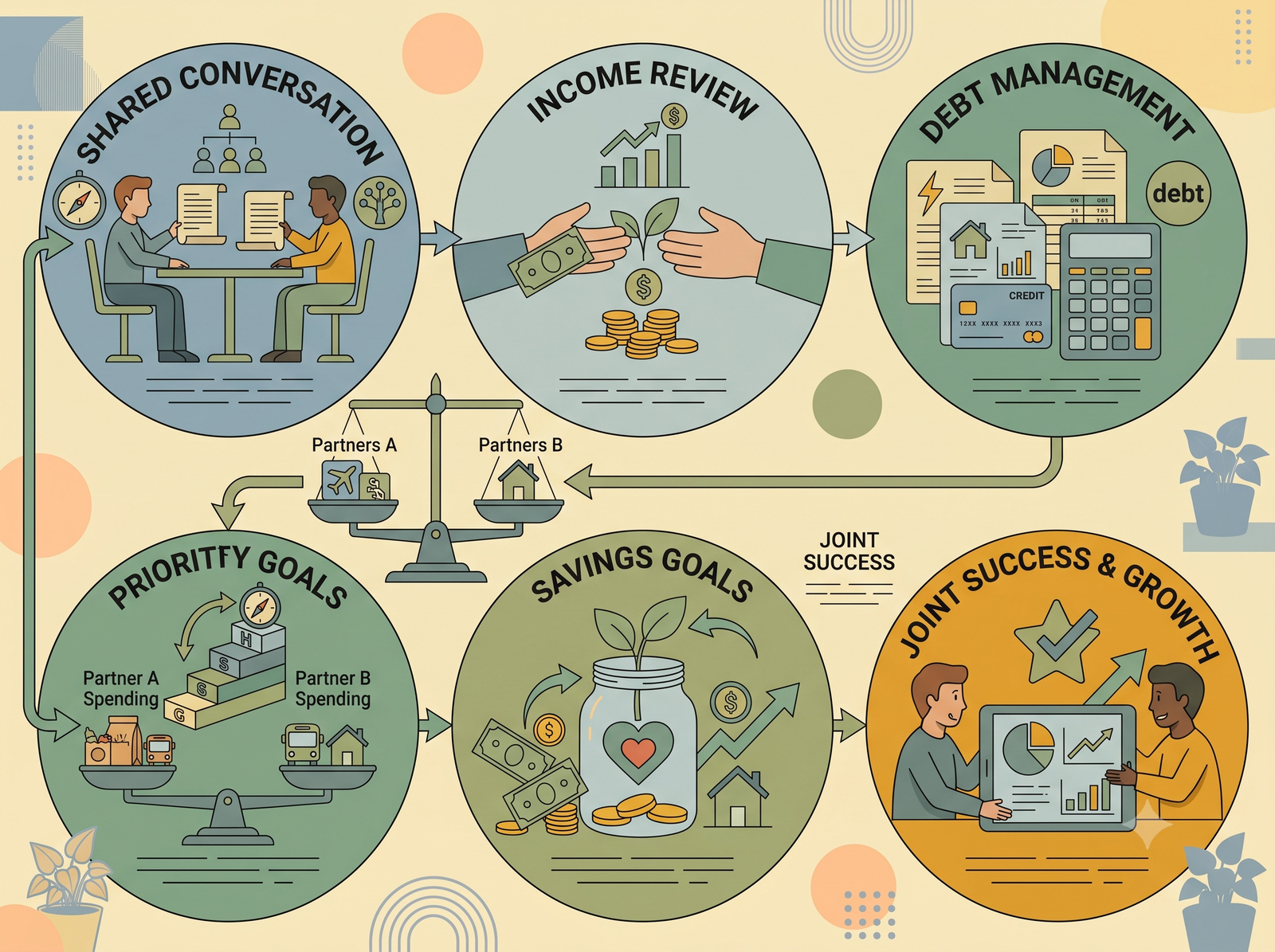
Money is one of the most practical parts of a relationship, but it can also be one of the most emotional.
Partners may disagree about:
- How much to spend
- Whether to combine finances
- How to divide bills
- How much to save
- Whether to support family members
- How to handle debt
- What counts as a necessary purchase
- How much privacy each person should have
- When to buy a home or make another major commitment
These disagreements do not automatically mean a relationship is unhealthy. Two people can love each other and still have different money habits, backgrounds, expectations, and priorities.
The real problem is usually not that partners disagree. It is that they avoid conversations until a bill, debt, purchase, or financial emergency forces the issue.
This guide explains how to talk about money with your partner without turning every discussion into a fight. It covers financial backgrounds, income differences, shared bills, separate accounts, debt, financial goals, boundaries, and regular money check-ins.
These ideas also connect to building a healthy relationship with money and setting financial goals.
Why Money Conversations Feel So Difficult
Money discussions often involve more than numbers.
A conversation about spending may also feel like a conversation about:
- Responsibility
- Trust
- Freedom
- Security
- Power
- Independence
- Family expectations
- Personal success
- Fear of the future
One partner may hear “we need to reduce spending” as criticism. Another may hear “I want to keep my account separate” as a lack of trust.
These emotional reactions are often connected to past experiences.
Someone who grew up with financial instability may value emergency savings above almost everything else. Someone who grew up in a household that avoided discussing money may feel uncomfortable sharing account details. Someone who had to become financially independent early may be protective of personal control.
Understanding the emotion behind a money position can make it easier to discuss the actual issue.
Instead of asking:
Why are you so careless with money?
Try asking:
What does financial security mean to you, and what experiences shaped that view?
The goal is not to agree on every financial decision. It is to understand what the decision represents to each person.
Start Talking About Money Before a Crisis
Do not wait until:
- A credit card is nearly full
- Rent is overdue
- A major purchase has already been made
- A loan application is underway
- A family member asks for money
- A job loss occurs
- A bill becomes impossible to pay
Begin with smaller, lower-pressure conversations.
You can discuss:
- What you learned about money growing up
- What makes you feel financially secure
- What you enjoy spending on
- What expenses you dislike
- Whether you prefer saving or spending
- What financial goals matter to you
- How you define a comfortable lifestyle
These conversations help you understand each other before you are negotiating a difficult decision.
Money conversations should become a normal part of relationship communication, not an emergency-only topic.
Learn Each Other’s Financial Backgrounds
Each partner should have a chance to explain:
- What money was like in their childhood home
- Whether money was stable or uncertain
- How their family handled debt
- What they were taught about saving
- Whether they received financial support
- What financial mistakes they have experienced
- What they are proud of
- What they are worried about
You do not need to share every detail during one conversation. Start gradually.
The purpose is not to investigate or judge. It is to understand why your partner may make certain decisions.
For example, one person may prefer to spend on experiences because they grew up with few opportunities to travel. Another may prefer to save aggressively because they remember housing insecurity.
Neither response is automatically correct or incorrect. The couple needs to create a shared plan that respects both perspectives.
Share Important Financial Information Honestly
Partners do not necessarily need to combine every account, but they should understand information that affects shared decisions.
Discuss:
- Income
- Regular expenses
- Debt
- Credit obligations
- Childcare responsibilities
- Financial support given to family
- Major subscriptions
- Savings
- Financial goals
- Legal or contractual obligations
Hidden debt or undisclosed financial commitments can damage trust because the problem becomes larger when discovered later.
You can maintain personal privacy while still being honest about shared responsibilities. For example, each partner may keep a personal spending account, but both people should know how much money is available for rent, utilities, food, and agreed goals.
The level of detail depends on the relationship, but major obligations should not be hidden when they affect the household.
Choose a Fair Way to Divide Shared Expenses
There is no single correct way to divide household costs.
Possible methods include:
Equal Split
Each partner pays half of shared expenses.
This may work when:
- Incomes are similar
- Responsibilities are similar
- Both people agree
- Expenses are manageable for both
Proportional Split
Each partner contributes based on income.
For example, if one partner earns 60% of the household income and the other earns 40%, shared bills may be divided using the same percentages.
This method can feel fair when incomes are significantly different.
Responsibility-Based Split
Partners divide expenses according to categories.
For example:
- One partner handles rent
- The other handles groceries and utilities
This can be simple, but compare the totals regularly. The categories may not remain equal.
Shared Account With Personal Accounts
Both partners contribute an agreed amount to a shared account for household expenses. Each person keeps a separate account for personal spending.
This structure can provide both cooperation and independence.
Fully Combined Finances
Some couples combine most or all income and expenses. This can work when both people are comfortable with transparency and shared decision-making.
The arrangement should be voluntary. Combining accounts does not automatically create trust, and keeping accounts separate does not automatically mean a lack of commitment.
Discuss What Counts as a Shared Expense
Shared costs may include:
- Rent or mortgage
- Utilities
- Groceries
- Internet
- Transportation
- Insurance
- Childcare
- Home repairs
- Shared subscriptions
- Family activities
- Pet costs
- Household supplies
Personal expenses may include:
- Personal clothing
- Individual hobbies
- Personal subscriptions
- Gifts to friends
- Personal debt from before the relationship
- Individual beauty services
- Private entertainment
- Support for relatives, unless agreed otherwise
Some costs require a conversation. For example, a personal subscription may become shared if both partners use it. A family gift may require discussion if it affects the household budget.
The key is not to assume. Discuss the category before resentment develops.
Set a Purchase-Approval Limit
Couples may disagree about whether they need approval for purchases.
One useful compromise is to set a purchase amount that requires discussion.
For example:
- Purchases under $50 are personal decisions
- Purchases over $200 are discussed before buying
- Major commitments require agreement from both partners
The amount should fit your income and financial situation.
A purchase may also require discussion if it:
- Creates a recurring payment
- Uses shared savings
- Adds debt
- Affects childcare
- Changes housing
- Requires a contract
- Reduces the emergency fund
The purpose is not to control each other’s spending. It is to protect shared goals and prevent major surprises.
Create Shared Financial Goals
A shared goal gives money conversations direction.
Possible goals include:
- Building an emergency fund
- Paying off debt
- Moving
- Buying a vehicle
- Planning a wedding
- Saving for travel
- Starting a business
- Preparing for a child
- Supporting education
- Buying a home
- Reducing work hours in the future
Create a goal that includes:
- Target amount
- Purpose
- Deadline
- Monthly contribution
- Responsibility for each partner
- Review date
For example:
We will save $2,400 for a moving fund within twelve months by contributing $100 each month and directing half of any extra income toward the goal.
If incomes differ, contributions do not necessarily need to be equal. The important part is agreeing on what feels fair and realistic.
Our guide on how to set financial goals provides a more detailed framework.
Talk About Family Financial Support
Family support can become a sensitive subject.
Discuss:
- Whether either partner sends money to family
- How often support is expected
- Whether the support is temporary or ongoing
- Whether it comes from personal or shared money
- What happens during a family emergency
- What limits protect the household budget
Helping family can be meaningful, but support should not quietly prevent the household from paying essential bills or building basic financial stability.
Create a shared boundary such as:
We will contribute up to a certain amount each month without affecting rent, bills, or emergency savings.
The appropriate boundary depends on your family, culture, income, and responsibilities. The important point is to make the arrangement visible.
Manage Debt as a Team
Debt may belong to one partner individually, but it can still affect shared decisions.
Discuss:
- Total balances
- Interest rates
- Minimum payments
- Repayment goals
- Whether shared money will be used
- Whether new debt is acceptable
- How large purchases will be handled
Avoid using shame when discussing debt. Shame can encourage secrecy and avoidance.
Instead, focus on:
- What is owed
- What the required payments are
- Which balance is most expensive
- How repayment fits into the budget
- What actions are realistic
If one partner has debt from before the relationship, the couple should discuss what support is voluntary and what obligations are shared.
Hold Regular Money Meetings
A money meeting does not need to feel formal or intimidating.
Set aside 20 to 30 minutes to review:
- Income received
- Bills due
- Recent spending
- Savings progress
- Debt payments
- Upcoming expenses
- Changes in work or family responsibilities
- One adjustment for the next month
Choose a calm time. Do not begin the conversation in the middle of an argument or immediately after discovering an unexpected purchase.
Use a shared document or spreadsheet if helpful. End the meeting with clear next steps:
- Who will pay which bill?
- How much will be transferred?
- What expense will be reviewed?
- What goal needs attention?
- When will you check in again?
Regular short conversations are usually easier than one long conversation after months of avoidance.
Use Respectful Money Language
Avoid statements that attack a person’s character.
Instead of:
You are terrible with money.
Try:
I am worried that this spending pattern is making our monthly budget difficult.
Instead of:
You never let us enjoy anything.
Try:
I want to find a way to save while still making room for experiences we value.
Instead of:
You are hiding everything from me.
Try:
I feel anxious when I do not know what obligations affect our shared finances. Can we agree on what information we will share?
Focus on:
- The specific behavior
- The financial effect
- The shared goal
- A possible next step
Listening is equally important. Each person should have an opportunity to explain concerns without being interrupted.
Common Money Mistakes Couples Make
Avoiding Money Conversations
Silence does not create agreement. It often creates assumptions.
Combining Finances Too Quickly
Shared accounts should be created after discussing expectations, access, spending, and responsibilities.
Keeping Major Debt Secret
Undisclosed debt can affect housing, borrowing, and daily budgets.
Treating Equal as Automatically Fair
Equal contributions may place a greater burden on the lower-income partner.
Controlling Every Personal Purchase
A shared budget should not become a system for monitoring every small decision.
Making Large Purchases Without Agreement
New debt, contracts, or withdrawals from shared savings should usually be discussed.
Assuming One Partner Should Manage Everything
Both people should understand the household’s major bills and financial obligations.
Using Money as Punishment
Withholding basic support, hiding accounts, or controlling access to essentials can create serious financial harm. Healthy financial communication includes safety, respect, and reasonable independence.
Bringing Up Old Mistakes Repeatedly
Discuss the current plan instead of using past errors as permanent weapons.
Expecting Perfect Agreement
Partners can have different priorities and still cooperate effectively.
A Realistic Couples Budget Example
Imagine a couple with combined monthly take-home income of $4,500.
Their shared expenses are:
| Category | Monthly Amount |
|---|---|
| Housing and utilities | $1,650 |
| Groceries | $500 |
| Transportation | $450 |
| Insurance | $300 |
| Debt payments | $350 |
| Phone and internet | $150 |
| Emergency savings | $400 |
| Long-term goal | $300 |
| Personal spending | $300 |
| Miscellaneous | $250 |
| Total | $4,650 |
The couple is spending approximately $150 more than their income.
Instead of blaming each other, they review the categories and decide to:
- Reduce delivery and grocery waste by $100
- Review phone and internet plans and save $30
- Reduce miscellaneous spending by $70
- Delay a planned upgrade until the budget improves
The changes create approximately $200 of room. The extra amount can cover the shortfall and provide a small buffer.
The couple does not need to eliminate every personal expense. They need to work from shared information and agree on the trade-offs.
Frequently Asked Questions
How do I start talking about money with my partner?
Choose a calm time and begin with values rather than criticism. Ask what financial security means to each person, what goals matter, and what money habits were learned growing up.
Should couples combine their bank accounts?
There is no universal answer. Some couples combine finances, while others use shared and personal accounts. The best structure is one that provides transparency for shared responsibilities while respecting both partners’ comfort and independence.
How should couples split bills when incomes are different?
Options include equal splitting, proportional contributions, category-based responsibility, or a shared account. Discuss what feels fair based on income, time, responsibilities, and household needs.
Should partners disclose all debt?
Major debts and obligations that affect shared decisions should generally be discussed. Hiding significant debt can damage trust and make planning difficult.
How often should couples discuss money?
A short monthly review is useful for many couples. More frequent conversations may help during a move, job change, debt repayment, or major financial transition.
What if my partner refuses to discuss money?
Explain why the conversation matters and choose a low-pressure starting point. If financial secrecy, control, or conflict continues, consider help from a qualified counselor or financial professional.
How can couples disagree about spending without arguing?
Use specific numbers, respectful language, and shared goals. Discuss the financial effect of a purchase rather than attacking the person who made it.
Should personal spending require approval?
Couples can set an agreed purchase limit. Small personal purchases may not need approval, while large purchases, new debt, or use of shared savings may require a conversation.
Key Takeaways
- Money conversations are easier when they happen regularly rather than only during emergencies.
- Discuss financial backgrounds, expectations, income, debt, family responsibilities, and goals.
- Choose a bill-splitting method that reflects your household and feels fair to both people.
- Decide which expenses are shared and which remain personal.
- Consider using shared and personal accounts together.
- Set a purchase-approval limit for large expenses, new debt, and withdrawals from shared savings.
- Create shared goals with specific amounts, deadlines, and contributions.
- Give each partner some personal spending freedom when possible.
- Review money together monthly and agree on clear next steps.
- Use respectful language focused on behavior, impact, and solutions.
- Readers can continue with building a healthy relationship with money, setting financial goals, and household budgeting for families.
- The needs versus wants guide can also help couples discuss spending priorities.
Talking about money with a partner is not about making every decision identical. It is about creating enough honesty and cooperation that both people understand the household’s reality.
Begin with one conversation about what financial security means to each of you. Then discuss one shared expense, one goal, or one habit that could improve. Small, respectful conversations can create more trust than one dramatic attempt to solve every financial issue at once.
This article is for informational purposes only and is not financial advice.
2 thoughts on “Money and Relationships: How to Talk About Finances With a Partner”