






Budgeting can feel difficult when your income is small. It may seem as though there is nothing left to plan after paying for food, transportation, phone service, school costs, or other basic expenses.
The challenge becomes even greater when your income changes from week to week. A part-time job may provide more hours during some months and fewer during others. Students and teenagers may also receive money from different sources, such as allowances, seasonal work, family support, or occasional freelance jobs.
A budget does not create extra money by itself, but it can help you use limited income more deliberately. It shows which expenses must be paid first, which costs can be adjusted, and where a small amount of money can be directed toward future needs.
This guide explains how to budget on a small income, how to manage irregular pay, prioritize essential expenses, control flexible spending, and save even when the amount is modest. It builds on the wider principles in our personal finance guide for students and is also useful for teenagers, part-time workers, freelancers, and anyone starting with limited income.
Why Budgeting on a Small Income Feels Different
A budget is often presented as a simple formula:
Income minus expenses equals savings.
That formula is correct, but it does not describe the reality of someone whose income barely covers essential expenses.
When income is limited:
- A small price increase can affect the entire month
- One unexpected repair can create debt
- Irregular work hours make planning difficult
- Fixed costs take up a larger percentage of income
- There may be less room to reduce expenses
- Saving can feel impossible
- A single missed payment can cause serious stress
This does not mean budgeting is pointless. It means the budget needs to focus on the right priorities.
When income is small, the first goal may not be investing or saving a large percentage. The first goal may be:
- Covering essential needs
- Avoiding late fees and expensive debt
- Creating a small buffer
- Planning for irregular expenses
- Improving income when possible
Do not judge your budget against someone with a much higher income. The purpose is to make your actual situation clearer and more manageable.
Start With Your Lowest Reliable Income
If your income changes, do not build your budget around your best month.
Instead, calculate the lowest amount you can reasonably expect.
For example:
- Week 1: $240
- Week 2: $310
- Week 3: $180
- Week 4: $275
If your income varies, using $180 or a conservative average may be safer than assuming $310 will arrive every week.
For a part-time job, estimate your income using:
- Your lowest regular number of hours
- Your after-tax pay
- Seasonal changes
- Unpaid time off
- Reduced work during exams or holidays
For freelance work, use money that has already been received or is highly likely to arrive. Do not spend money based only on an invoice that has not been paid.
A conservative income estimate may make your budget feel tighter, but it reduces the risk of overspending during a low-income period.
When extra income arrives, you can assign it separately rather than relying on it for regular bills.
Separate Income Into Three Groups
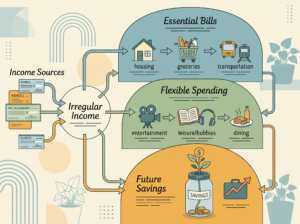
1. Regular Income
Use reliable income to cover predictable expenses.
Examples include:
- Rent
- Phone
- Transportation
- Basic food
- School expenses
- Minimum debt payments
- Utilities
2. Variable Income
Variable income can be used for flexible costs, but only after essential needs are covered.
Examples include:
- Extra shifts
- Tips
- Freelance payments
- Overtime
- Occasional work
3. Extra or Unexpected Income
This may include:
- A bonus
- A gift
- A refund
- A seasonal payment
- Money from selling unused items
You can divide extra money among immediate needs, savings, debt, and planned spending.
The important habit is not allowing every extra payment to become a permanent increase in lifestyle costs.
List Your Essential Expenses First
Before deciding how much to spend on entertainment or savings, list the expenses that protect your basic needs.
Essential expenses may include:
- Housing
- Basic groceries
- Electricity and water
- Transportation required for work or school
- Phone service
- Medication
- Insurance
- Childcare
- Minimum debt payments
- Required school expenses
Some expenses are partly essential and partly optional.
For example:
- A phone may be essential, but an expensive upgrade is optional.
- Transportation may be necessary, but a larger vehicle may not be.
- Food is essential, but delivery fees and premium snacks are flexible.
- Internet may be necessary for work or education, but the fastest plan may not be required.
This is why the needs versus wants framework is useful. It helps you separate the basic function of a purchase from optional features or convenience.
Build a Bare-Bones Budget
A bare-bones budget is a temporary plan that covers only the expenses required to keep your household functioning.
It may include:
- Housing
- Basic utilities
- Basic food
- Necessary transportation
- Medication and essential healthcare
- Minimum debt payments
- Required work or school expenses
This is not necessarily the budget you should use forever. It is a useful starting point when income falls or you are trying to understand the minimum amount you need each month.
Once the bare-bones total is clear, compare it with your lowest reliable income.
If Income Is Higher Than Essential Costs
You may have room for:
- Savings
- Debt repayment
- Flexible spending
- Education
- Planned purchases
- Personal goals
If Income Is Close to Essential Costs
Focus on:
- Preventing overdrafts
- Building a small buffer
- Reducing flexible expenses
- Reviewing major bills
- Finding reliable income opportunities
If Income Is Lower Than Essential Costs
The problem may require more than spending cuts. Consider:
- Additional work
- Assistance programs
- Lower-cost housing
- Family support
- School resources
- Debt counseling
- Renegotiating bills
- Community support
Do not rely on extreme deprivation to solve a long-term income gap.
Use Weekly Amounts Instead of Only Monthly Categories
A monthly amount can be difficult to manage when money arrives weekly or biweekly.
After setting aside fixed bills, divide the remaining amount into weekly limits.
For example, suppose you have $480 available for flexible costs after paying fixed expenses:
- Groceries: $220
- Transportation: $100
- Personal spending: $80
- Savings: $50
- Miscellaneous: $30
You might divide grocery money into approximately $55 per week and personal spending into $20 per week.
The numbers do not need to be exact. The point is to make the available money visible.
A weekly system can also help prevent spending too much immediately after payday. If your income arrives in one payment, divide it into weekly portions rather than treating the entire amount as available at once.
Plan for Irregular Expenses
Small-income budgets are often disrupted by expenses that are predictable but not monthly.
These may include:
- School supplies
- Clothing
- Annual fees
- Vehicle maintenance
- Birthdays
- Travel
- Medical appointments
- Technology repairs
- Seasonal utilities
- Registration payments
- Holiday expenses
Create a list of irregular expenses and estimate the yearly total.
For example:
| Expense | Estimated Annual Cost |
|---|---|
| School supplies | $240 |
| Vehicle maintenance | $360 |
| Gifts | $180 |
| Annual fees | $120 |
| Clothing | $240 |
| Total | $1,140 |
Dividing $1,140 by twelve gives an average of $95 per month. If you cannot save that much immediately, save what is realistic and prioritize the expenses that are most important.
A small amount set aside regularly is better than being surprised by every annual bill.
Save Money on a Small Income
Saving on a small income requires realistic expectations.
You may not be able to save hundreds of dollars every month. Begin with a small target that you can repeat.
Possible starting amounts include:
- $5 per week
- $10 per paycheck
- $25 per month
- A percentage of extra income
- The value of one reduced expense
The first goal may be a starter emergency fund of $50, $100, or $250.
This money can help with:
- A transportation problem
- A small medical cost
- A school requirement
- A replacement item
- A delayed paycheck
- An essential household need
Keep the money separate from everyday spending if possible. An automatic transfer can make saving easier because it removes the need to make the decision repeatedly.
If your income is extremely limited, focus first on avoiding new high-interest debt. Preventing a new financial problem can be as valuable as building savings.
Reduce Expenses Without Trying to Cut Everything
A small-income budget does not need to eliminate every enjoyable activity. Start with expenses that provide low value or repeat automatically.
Review:
- Unused subscriptions
- Delivery fees
- Convenience snacks
- Frequent ride-hailing
- Unplanned online shopping
- Expensive phone plans
- Unused memberships
- Duplicate services
- Food waste
- Impulse purchases
For food, use the strategies in how to save money on groceries, including meal planning, leftovers, store brands, unit-price comparisons, and emergency meals.
For recurring bills, review how to lower monthly bills to identify services, utilities, and plans that may be reduced.
The goal is to reduce waste while protecting expenses that are important to your health, education, work, and relationships.
Handle Variable Pay Carefully
If your income changes, create a system for handling each payment.
A simple method is:
First: Cover Upcoming Essentials
Before spending extra money, check whether rent, groceries, transportation, bills, or school expenses are due.
Second: Set Aside a Small Buffer
Move a portion into savings or a separate holding category.
Third: Prepare for Irregular Costs
Add money to categories such as repairs, school, clothing, or annual fees.
Fourth: Use the Remainder Flexibly
After essentials and future costs are covered, you can use remaining money for personal spending or debt repayment.
This method prevents a large paycheck from creating the illusion that all of the money is available for immediate use.
Increase Income Where Possible
Budgeting can help you spend more intentionally, but there may be a limit to how much you can cut.
Consider income opportunities that fit your schedule and skills:
- Extra shifts
- Tutoring
- Freelance work
- Pet care
- Babysitting
- Selling unused items
- Seasonal work
- Campus employment
- Paid internships
- Basic technology services
- Food preparation
- Local errands
Calculate the real benefit after transportation, equipment, taxes, and time.
A job that pays more but creates large travel costs may not improve your situation as much as expected. Similarly, extra hours that cause exhaustion or interfere with education may be difficult to sustain.
If you are a student, protect your academic responsibilities while exploring additional income.
Create a Simple Low-Income Budget System
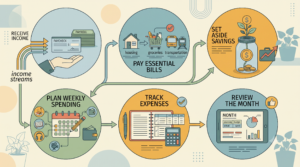
Use the following routine every time you receive income.
Step 1: Record the Amount Received
Write down the actual amount, not the amount you expected.
Step 2: Check Upcoming Bills
Review the next two to four weeks and identify what must be paid.
Step 3: Set Aside Essential Costs
Move money for housing, utilities, food, transportation, and minimum payments first.
Step 4: Add to a Buffer or Sinking Fund
Even a small amount can help prepare for irregular expenses.
Step 5: Set a Weekly Spending Limit
Divide the remaining money among groceries, transport, personal spending, and other flexible categories.
Step 6: Track Purchases
Use a simple note or spreadsheet so you know how much remains.
Step 7: Review Before the Next Payment
Ask what worked, what went over budget, and what needs adjusting.
This system does not need to be complicated. Consistency is more valuable than a perfect spreadsheet.
Common Mistakes When Budgeting on a Small Income
Building a Budget Around Your Best Month
A budget based on your highest income may fail when work hours decline. Use a conservative income estimate.
Forgetting Irregular Expenses
If you do not plan for annual costs, they will feel like emergencies.
Saving an Unrealistic Amount
A savings goal that makes it impossible to buy food or pay bills will not last. Start smaller if necessary.
Treating Every Expense as Essential
Some purchases may be useful but flexible. Distinguish basic needs from optional upgrades and convenience.
Using Credit to Fill Every Gap
Credit may provide temporary relief but can create interest and payment problems later.
Ignoring Small Repeated Purchases
Small expenses matter when they happen frequently. Track them for a month before deciding what to change.
Refusing All Enjoyment
A budget with no personal spending may lead to frustration and eventual overspending. Include a modest, planned amount when possible.
Comparing Your Budget to Someone Else’s
Income, family support, rent, health, location, and responsibilities differ. Focus on your own progress.
Trying to Fix the Whole Situation in One Week
Make a few changes, observe the result, and adjust gradually. Sustainable budgeting is built through repetition.
A Realistic Part-Time Job Budget Example
Consider a student earning between $1,200 and $1,600 per month from part-time work and family support.
The student chooses $1,200 as the foundation for the regular budget.
| Category | Monthly Amount |
|---|---|
| Housing contribution | $400 |
| Groceries | $220 |
| Transportation | $100 |
| Phone | $40 |
| School expenses | $100 |
| Personal spending | $80 |
| Savings | $50 |
| Debt payment | $75 |
| Irregular expense fund | $75 |
| Total | $1,140 |
This leaves $60 of flexibility in the lowest-income month.
When income reaches $1,600, the additional $400 could be divided:
- $150 toward emergency savings
- $100 toward upcoming school expenses
- $75 toward debt repayment
- $50 toward a planned personal goal
- $25 for flexible spending
The exact amounts are only examples. The principle is to build regular expenses around the lower income and give higher income a planned purpose.
What to Do When Income Is Not Enough
Sometimes the numbers show that essential expenses are higher than income. This is not always a budgeting failure.
Possible steps include:
Review Large Costs First
Housing, transportation, childcare, and debt payments may matter more than small purchases.
Contact Providers Early
Some schools, utility providers, lenders, or service organizations may offer payment plans or assistance options. Ask before a bill becomes overdue.
Use Available Support
Students may have access to:
- Financial aid offices
- Food support
- Emergency grants
- Transportation assistance
- Counseling
- Community programs
- Career services
Seek Reputable Debt Guidance
If you are struggling with multiple debts, consult a qualified, reputable counselor rather than ignoring the problem or accepting unrealistic promises.
Avoid High-Cost Quick Fixes
Be cautious with payday loans, high-fee cash advances, and borrowing arrangements that hide the total repayment cost.
A budget can identify the gap, but solving the gap may require support, increased income, lower fixed costs, or a combination of these.
Frequently Asked Questions
How do I budget when my income is very small?
Start with your lowest reliable income and list essential expenses first. Set weekly limits for flexible spending, reduce avoidable costs, and save a small amount if possible. If essential costs exceed income, consider additional support or income rather than relying only on extreme cuts.
How can I budget with an irregular part-time paycheck?
Use a conservative income estimate and create a system for each payment. Pay upcoming essentials first, set aside money for irregular expenses, then divide what remains into weekly spending amounts.
Should I save money if I have a small income?
If your basic expenses are covered, saving even a small amount can help create a buffer. If you are unable to cover essential costs or have urgent high-interest debt, focus on stabilizing those issues while saving what is realistic.
What percentage of income should I save?
There is no universal percentage. A small, consistent amount is better than an unrealistic target. Your savings rate may change as your income, expenses, and responsibilities change.
How can teenagers start budgeting?
Teenagers can track allowance, wages, gifts, and spending. Separate money for needs, personal spending, savings, and future purchases. Starting with simple categories is enough.
How can I stop running out of money before payday?
Track spending, divide money into weekly amounts, plan food and transportation, and set aside upcoming bills as soon as income arrives. Avoid treating the entire paycheck as available for immediate spending.
Is it better to pay debt or save first?
The right balance depends on the debt’s interest rate, required payments, and your access to emergency money. Continue required payments and consider building a small buffer so minor emergencies do not create new debt.
What if I cannot afford anything beyond basic needs?
Focus on essential stability first. Review large fixed costs, seek eligible support, look for income opportunities, and contact providers before payments become overdue. A budget can help identify the problem, but it cannot create money that is not available.
Key Takeaways
- Budgeting on a small income begins with realistic expectations, not complicated formulas.
- Use your lowest reliable income when planning regular expenses.
- Separate essential costs, flexible spending, savings, and irregular expenses.
- Use weekly limits if you receive money weekly or struggle with monthly planning.
- Build small sinking funds for predictable costs such as school supplies, repairs, and annual fees.
- Save a modest amount when possible, but do not set a goal that makes essential bills unaffordable.
- Track small purchases because repeated expenses can affect a limited budget.
- Review groceries, subscriptions, transportation, phone plans, and convenience costs.
- Be careful with high-interest borrowing and quick-fix financial products.
- Extra income should receive a purpose instead of automatically increasing regular spending.
- Readers can continue with personal finance for students, how to build good money habits before graduation, and frugal living tips.
- Understanding needs versus wants can also make it easier to decide what to reduce first.
A small income does not make financial planning pointless. It makes clarity even more important. When every dollar has several possible jobs, deciding what comes first can reduce stress and prevent avoidable problems.
Start by tracking what you earn and spend. Build your regular life around conservative income, plan for irregular costs, and make small adjustments that you can repeat. Your budget may not be perfect, but it can still give you more control over the money you have today.
This article is for informational purposes only and is not financial advice.