







Most people spend more hours learning to drive a car than they ever spend learning how money actually works. School teaches algebra and world history, but rarely explains how a credit score is built, why a budget matters, or what happens to $50 a month invested for twenty years. If you’ve ever felt like everyone else got a “money manual” you never received, you’re not alone — and you’re not behind. You’re just starting now.

This guide breaks down financial literacy for beginners into the handful of concepts that actually matter, without jargon, without judgment, and without assuming you already know the basics. By the end, you’ll understand exactly how to read your own finances, where to start improving them, and which habits build wealth over time — even if you’re starting from zero.
What Is Financial Literacy, and Why Does It Matter?
Financial literacy is simply the ability to understand and use money skills effectively — budgeting, saving, spending, borrowing, and investing. It’s not about being a finance expert or knowing complicated formulas. It’s about being able to answer basic questions confidently: Am I spending more than I earn? Am I prepared for an unexpected expense? Is my money growing or shrinking over time?
Studies on financial behavior consistently find the same pattern: people who understand these basics make measurably better decisions — they carry less high-interest debt, save more consistently, and report lower financial stress. That’s the real payoff of financial literacy. It’s not about getting rich quickly. It’s about removing the fog around money so you can make decisions on purpose instead of by accident.
Personal finance education varies wildly by school district, and even where it exists, it’s often a single semester crammed between other requirements. That gap is exactly why so many adults learn money management through trial and error — usually the expensive way, through a maxed-out credit card or a loan they didn’t fully understand. This guide is designed to shortcut that trial-and-error process.
It’s also worth naming something directly: financial literacy isn’t just a knowledge gap, it’s often an emotional one too. Money carries shame, comparison, and anxiety for a lot of people — which is part of why avoidance feels easier than looking closely. Nothing below requires you to have it figured out already. It’s written for the version of you that’s starting today, not the version you wish had started five years ago.
Pillar 1: Budgeting (Knowing Where Your Money Goes)
A budget is simply a plan for your income before you spend it, rather than a mystery you solve after the fact by checking your bank balance. At its core, budgeting means tracking three numbers: what comes in, what goes out, and what’s left over.
The reason budgeting feels intimidating for so many beginners is that it’s often framed as restriction — a list of things you’re no longer allowed to buy. In practice, a working budget is closer to a map than a set of rules. It doesn’t tell you that you can’t spend on something; it tells you what happens to the rest of your money if you do. That distinction matters, because rules people resent tend to get abandoned within a few weeks, while a map people actually understand tends to get used.
How to build the habit: Track spending for a full month before changing anything. Awareness alone tends to shift behavior even before a formal plan exists.
Pillar 2: Saving (Building a Buffer)
Saving isn’t just about long-term goals like a house or retirement — it starts with having a cushion for the unexpected: a car repair, a medical bill, a slow month at work. Without savings, every surprise expense becomes debt.
This is one of the most underrated pieces of financial literacy, because it’s rarely dramatic. A well-funded savings cushion doesn’t show up as an exciting win — it shows up as the absence of a crisis. The month your car needs a $600 repair and you simply pay for it and move on, instead of putting it on a credit card at 24% interest, is the entire point of building savings in the first place.
How to build the habit: Automate a small, fixed transfer to savings on payday, even if it’s just $20. Removing the decision removes the willpower requirement.
Pillar 3: Debt & Credit (Borrowing Wisely)
Not all debt is bad, but understanding the difference between debt that builds your future (like a reasonable student loan) and debt that erodes it (like high-interest credit card balances) is central to financial literacy.
A useful way to think about it: debt is a tool that moves future money into the present. Sometimes that trade is worth it — a mortgage lets you live in a home decades before you could pay cash for it outright. Sometimes it isn’t — high-interest debt used for things that lose value the moment you buy them (clothes, electronics, dining out) means paying significantly more than the original price over time, with nothing to show for the extra cost.
How to build the habit: List every balance, interest rate, and minimum payment in one place. Uncertainty is often more stressful than the number itself.
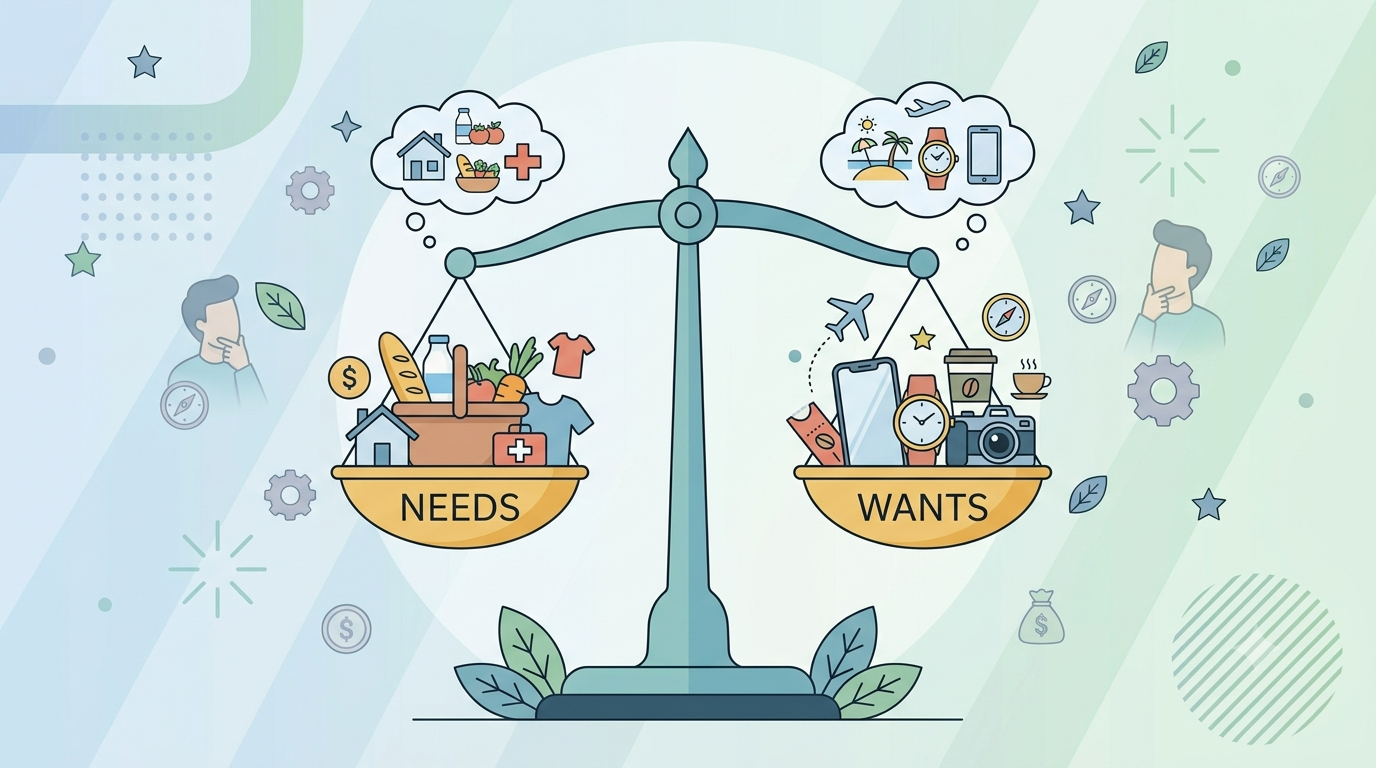
Pillar 4: Spending Awareness (Needs vs. Wants)
This is less about restriction and more about intention — knowing which purchases align with your actual priorities versus which ones are habitual or emotional.
Most spending isn’t a single dramatic decision; it’s dozens of small, low-friction ones — a subscription that renews quietly, a delivery order after a hard day, a purchase made because it was recommended rather than because it was needed. None of those individual choices are a problem on their own. The issue is that they rarely get evaluated at all, which is exactly what awareness is meant to fix.
How to build the habit: Before a non-essential purchase, pause for 24 hours. This filters out most impulse buying without requiring a strict “no.”
Pillar 5: Growing Money (Saving vs. Investing)
Saving protects money; investing grows it. Understanding the difference — and when to use each — is what separates short-term stability from long-term wealth-building.
The confusion between the two is one of the most common beginner mistakes, and it runs in both directions. Some people leave money meant for decades-away goals sitting in a low-interest savings account, where inflation quietly erodes its purchasing power year after year. Others invest money they’ll need soon, only to find themselves needing to sell during a downturn. Matching the right tool to the right timeline is what makes this pillar work.
How to build the habit: Keep short-term goals (under 3 years) in savings, and treat investing as a tool for goals further out, once the other four pillars feel stable.
A Step-by-Step Starting Point

| Step | What to Do | Why It Comes First |
|---|---|---|
| 1 | Track every expense for 30 days | You can’t manage what you can’t see |
| 2 | Calculate net income vs. total spending | Reveals whether you’re gaining or losing ground |
| 3 | Build a starter emergency fund ($500–$1,000) | Prevents small emergencies from becoming debt |
| 4 | List and organize any existing debt | Clarifies what you owe and at what interest rate |
| 5 | Create a simple monthly budget | Turns awareness into a repeatable system |
| 6 | Automate savings, even a small amount | Removes reliance on willpower |
| 7 | Learn the basics of investing | Only once steps 1–6 feel stable |
Step 1 — Track everything for 30 days. Use a notes app, spreadsheet, or budgeting app — the tool matters far less than the consistency.
Step 2 — Do the math. Add up total income and total expenses. A deficit is your starting problem; a surplus is your starting opportunity.
Step 3 — Build a small buffer first. A starter emergency fund of $500–$1,000 means a flat tire doesn’t automatically become a credit card balance.
Step 4 — Get a full picture of any debt. Listing every balance and rate in one place reduces anxiety as much as it clarifies strategy.
Step 5 — Build a simple budget. Many beginners start with a percentage-based framework — rough allocations toward needs, wants, and savings/debt — and adjust from there.
Step 6 — Automate what you can. An automatic transfer on payday builds the habit before it requires daily willpower.
Step 7 — Learn investing basics once the foundation is steady. Investing works best layered on top of stability, not as a substitute for it.
None of these seven steps need to happen quickly. Most people move through this sequence over several months, not several days, and that’s completely normal. The goal isn’t speed — it’s building each layer solidly enough that it holds up the next one. Skipping ahead to investing before a debt situation is understood, for example, often means later having to unwind investment decisions to cover a debt payment, which usually costs more in fees and lost growth than simply doing the steps in order the first time.
Common Financial Literacy Mistakes Beginners Make
- Waiting for a “big enough” income to start. Habits matter more than income size — many high earners still live paycheck to paycheck because habits never caught up.
- Avoiding the numbers instead of facing them. Financial anxiety often worsens, not improves, when bills go unopened and balances go unchecked.
- Treating budgeting as a one-time event. A budget isn’t a document made once — it’s a habit revisited monthly as life changes.
- Confusing saving with investing. Keeping long-term goals entirely in a low-interest savings account means inflation quietly erodes their value.
- Comparing your starting point to someone else’s progress. Financial literacy is cumulative, not a reflection of failure relative to others.
- Trying to fix everything at once. Attempting to overhaul budgeting, debt, saving, and investing simultaneously often leads to burnout within a few weeks. Sequencing — as outlined in the steps above — tends to hold up better than trying to do all five pillars at full intensity from day one.
A Realistic Example: Starting From Zero
Consider someone earning $3,200 a month with no savings and $2,400 in credit card debt. Month one is spent simply tracking spending — no changes yet, just observation. By month two, they discover $310 a month going to subscriptions and delivery fees they’d forgotten about. Cutting that in half frees up roughly $150 a month.
That $150 doesn’t need to be split perfectly. A reasonable approach: $75 toward a starter emergency fund until it hits $500, then redirected toward the credit card balance using extra payments above the minimum. Within about six months, the starter fund exists and the debt balance has meaningfully decreased — not because income changed, but because visibility and a plan did.
This is the core lesson of financial literacy: the math rarely requires dramatic income changes. It requires seeing the numbers clearly enough to make small, consistent adjustments.
Frequently Asked Questions
How long does it take to become financially literate?
There’s no fixed timeline, but most people notice a meaningful shift in confidence within 60–90 days of consistently tracking spending and following a basic budget.
Do I need a degree in finance to manage my own money well?
No. Personal finance is largely a handful of repeatable habits — tracking spending, saving consistently, avoiding high-interest debt, and understanding how money grows over time.
What’s the single best first step if I’m overwhelmed?
Start by tracking your spending for just one week without changing anything. Awareness alone tends to naturally shift behavior even before a formal plan exists.
Is financial literacy the same as being good at math?
Not really. It’s more about habits, awareness, and decision-making than complex calculations — most of the math involved is basic addition, subtraction, and percentages.
What if I’ve made a lot of financial mistakes already?
Nearly everyone has. Financial literacy isn’t about a clean history — it’s about the decisions made from this point forward. Past mistakes, including debt or missed savings, can be addressed using the same step-by-step approach outlined above; they don’t disqualify you from starting.
Key Takeaways
- Financial literacy is a learnable skill, not an innate talent — most people were never formally taught it.
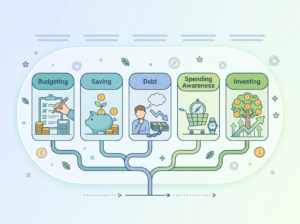
- The five core pillars are budgeting, saving, debt/credit management, spending awareness, and growing money through investing.
- Start with tracking and awareness before making changes — you can’t fix what you haven’t measured.
- Small, consistent habits (even automating $20 a month) compound into meaningful financial stability over time.
- Once the basics feel steady, learn how to measure real progress with your net worth and the difference between assets and liabilities. If you’re a student or young adult, see our full personal finance for students guide, or start cutting expenses right away with frugal living 101.
This article is for informational purposes only and is not financial advice.